
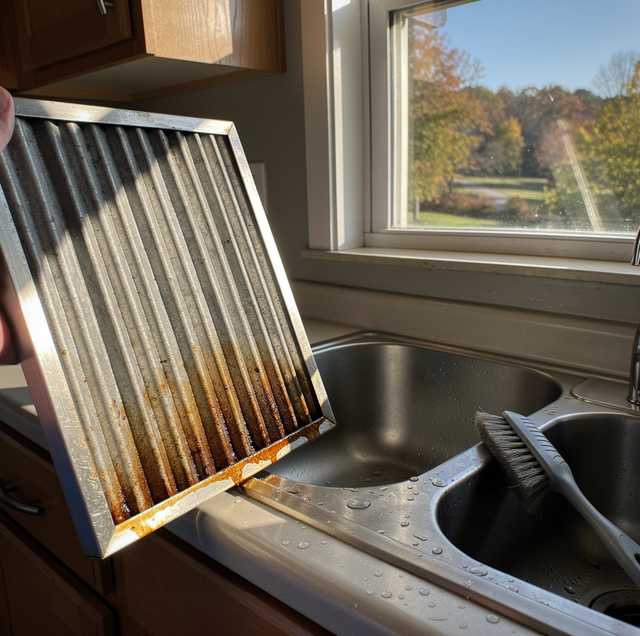
A range hood filter sits between the cooktop and the fan, and its job is to catch the grease that rides up in cooking air before that grease reaches the blower wheel and the duct. The filters that do this job are built differently: metal filters are washed and reused until the metal gives out, while a charcoal filter is thrown away once it is spent. The timing splits a second way as well, by what gets cooked under the hood, so the useful question for any kitchen is which filter it has and what sign says that filter is due.
Each filter a home hood can carry, matched to whether it is washed or replaced and to the sign that it is due:
| Filter | Washed or replaced | The sign it is due |
|---|---|---|
| Stainless baffle | Washed and reused | A slick film along the channels, or grease beaded on the bottom rail |
| Aluminum mesh | Washed and reused until the mesh or frame fails | Amber or brown strands that feel tacky, and little light showing through when the filter is held up to a lamp |
| Charcoal or carbon, in a recirculating hood | Replaced when spent; a disposable pad is never washed | Cooking smells that hang in the room after the fan has run |
| Microwave-hood grease filter | Washed and reused | A tacky, darkened screen on the underside of the microwave |
| Microwave-hood charcoal filter | Replaced | Odors lingering while the vent fan runs in recirculating mode |
How Grease Loads a Filter
Hot fat throws off fine droplets, and at searing heat some of it turns to vapor that condenses back into droplets as it rises into cooler air, so cooking air reaches the hood carrying a mist of liquid grease along with steam and smoke. A filter traps that mist by forcing the air to change direction. The air makes the turn; the heavier droplets cannot turn as quickly, so they strike the metal and stick.
An aluminum mesh filter is made of several layers of expanded mesh, and each strand is a surface for grease to collect. Each meal adds to the coat, and the film thickens until the openings between strands shrink. Kitchen dust settles into the tacky film, which is why a loaded mesh filter feels gritty and darkens from silver toward brown. A clogged screen also lets less air through, which shows up as the hood pulling weakly over the pan.
A stainless baffle filter works through a row of overlapping, angled channels. Air snakes between them, and grease collects on the channel walls and runs down to the lower edge, where it gathers along the bottom rail or drips into a trough in the hood. The openings in a baffle are wide, so grease can build up on it without closing the air path, and the evidence that it is due sits on the metal itself.
Whichever kind is fitted, the grease held in the filter is fuel, and it hangs directly above the burners.
A grease-soaked filter over a pan fire can ignite and carry flame up into the hood. Water on burning grease flashes to steam and throws the fire outward, and a fire in the hood is one for the fire department.
Cooking Style Sets the Timing
A filter becomes due when enough grease has reached it, and the amount that reaches it in any one meal is set by the fat in the pan and the heat under it. Pan-frying, deep-frying, searing meat, stir-frying over high heat and browning bacon all put a heavy grease mist into the air. Boiling pasta, simmering soup, and steaming vegetables send up water vapor with little fat in it.
So two kitchens with identical hoods reach the due sign after very different numbers of meals: one that fries or sears several nights a week, and one that sees a pot of rice and an occasional omelet. Checking the filter is what sets the schedule, and each filter's due sign shows where it stands.
Washing Baffle and Mesh Filters, Then Drying Them Fully
Before a filter is removed, the hood fan and hood light are switched off, and the filter has had time to cool. A halogen or incandescent lamp beside the filter runs hot, and a filter that has just been over a searing pan holds heat in its metal and its grease.
Filters are released by a spring latch, a finger tab, or a slide track, depending on the hood. A hand under the filter as the latch lets go keeps it from dropping onto the cooktop.
Hot water and dish soap cut filter grease. A soak with the filter lying flat and covered loosens the film, and a soft brush worked along the mesh or down each baffle channel lifts it. A wire brush or scouring pad can tear aluminum mesh. Rinsing from the side that faced the fan pushes loosened grease back out through the face it came in by.
Some stainless baffles and some aluminum mesh filters can go through a dishwasher, while others cannot, depending on the hood.
A washed filter goes back only when it is completely dry. Mesh holds water between its layers long after the face looks dry, and a damp filter drips onto the cooktop once it is overhead. Standing it on edge lets the trapped water run out.
While the filters are out, the hood stays off. Running the fan with an empty filter opening pulls the grease mist straight onto the blower wheel and into the duct, where a sink wash cannot reach it, and on some hoods it leaves the spinning blower open to fingers and utensils. Every filter goes back into its seat with its latch caught before the fan runs again.
Charcoal Filters Are Replacement Parts
A recirculating hood has no duct to the outdoors. It returns cooking air to the kitchen, so odor is handled by a charcoal or carbon filter: a pad or cartridge packed with activated carbon. Activated carbon is riddled with tiny pores, and odor molecules in the air cling to the surfaces inside them. Once those surfaces are covered, new odor passes through untouched.
Washing does not empty those pores. Soap and water do not pull the trapped odor compounds back out, and a soaked pad can clump, sag, or break apart in its frame. So a disposable charcoal pad or cartridge is replaced when it is spent and never washed; a long-life carbon block built to be washed and oven-dried is the one exception.
A spent carbon filter can look much the same as a new one, so its due sign shows up in the room. When smells hang on with a clean grease filter in place, the carbon is the part to change.
On some recirculating hoods the carbon clips onto the back of the metal grease filter; on others it sits in its own slot.
An over-the-range microwave that vents back into the room carries the same two filters: metal grease filters on its underside, which are washed, and a charcoal filter behind the vent grille across the top front, which is replaced.
When a Metal Filter Is Finished
A washable filter is reused until the metal fails, and the failures are visible.
A bent frame: A frame knocked out of true by a pot handle or a drop onto the floor no longer sits flat against the hood opening.
Torn or split mesh: A tear opens a hole straight through every layer, and air carrying grease takes that hole.
Gaps at the edges: Mesh that has pulled away from the frame, or a frame edge that has lifted, leaves a slot along the side where air slips around the filter.
A filter that will not seat: Latch tabs that have bent or snapped, or a frame that no longer fits its track, leave the filter hanging at one corner, where it can fall onto the cooktop.
Grease that will not wash out: Grease left long enough hardens into a varnish that soaking no longer lifts, and a mesh filter in that state stays clogged after every wash.
The first four faults do the same thing: air follows the path of least resistance, so grease-laden air passes through the opening and past the filter. A replacement matches the original in size, depth, and latch position; one that is a fraction off in any of those will not latch or will leave a gap of its own.
Grease That Gets Past the Filter
Grease that slips around a gap or through a tear lands on the parts behind the filter: the inside of the hood canopy, the blower wheel and its housing, and the motor. On the blower wheel, a grease coat adds weight to the blades and can throw the wheel off balance, which is heard as a new wobble or hum. Beyond the fan, the same grease continues into the duct and the damper.
Cleaning the blower wheel can mean taking it out of its housing, beside the motor wiring. For a homeowner, the work stops at the filter: reaching past the frame into the blower, the motor, or the wiring is service work, done with power to the hood shut off.
A failing filter leaves grease behind even after it is replaced, and a new filter under a greasy blower wheel still leaves fuel above the burners, so the hood interior is cleaned when a worn filter is removed.
Frequently Asked Questions
Dishwasher detergent is strongly alkaline, and alkaline solutions react with bare aluminum, leaving the mesh dull gray or darkened. The change sits on the surface and does not stop the filter from catching grease, though each run can darken it further. Stainless steel does not discolor from detergent that way, and hand washing an aluminum filter in dish soap and water avoids the reaction.
No. On hoods that have one, the reminder is a timer that counts the hours the fan has run and lights once it reaches a set total. It cannot see grease, so it can light over a clean filter or stay dark over a loaded one. Resetting it after a wash using that hood's button sequence restarts the count.
It can be, as long as it stayed sealed. Activated carbon takes up odors from whatever air reaches it, installed or not, so a spare left unwrapped in a cupboard or a garage spends part of its capacity before it goes in. A replacement kept in its original wrapping until it is fitted keeps that capacity.
Yes. The metal filter sits in front of the carbon filter and removes grease from the air first. Grease that reaches a charcoal filter coats the carbon and closes off the pores it uses to hold odors, so a carbon pad with a grease film on it is spent however new it is. A clean metal filter in place lets the carbon last until odor alone fills it.
On some models it does not. The charcoal filter on those units is used only when the microwave is set up to recirculate, and a unit ducted to the outdoors runs without one, since the duct carries the odors out of the house. A microwave switched from one setup to the other can gain or lose the filter.
The hood's model number is the reliable starting point. On some hoods, the model label sits inside the canopy, visible once the filters are out; on an over-the-range microwave, it can be on the frame around the door opening. Some filters also carry their own part number stamped on the frame, which identifies the replacement even when the hood's label has worn off.
Retain range hood repair for filter cleaning or replacement, and for hood cleaning—washing reusable filters, replacing disposable filters, and removing grease inside the hood. True Appliance Services Inc. serves Maryville, Alcoa, Knoxville. Call (865) 205-8717.