
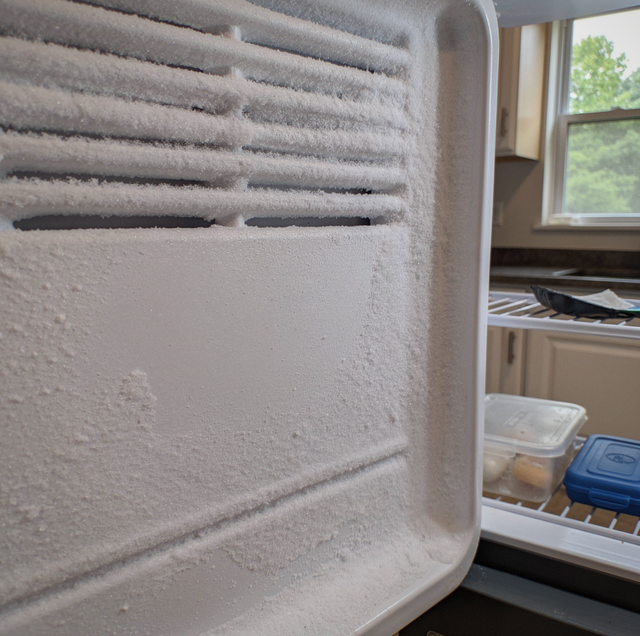
Ice has crept up the inside back wall of your freezer until it hides the vents, and no amount of chipping at it with a spatula keeps it away for more than a few days. The freezer is working exactly as hard as it always has to keep things cold; something else has changed.
A frost-free freezer is not a freezer that never frosts. It is a freezer that melts its own frost off several times a day, before that frost ever gets thick enough to notice, and visible frost means the melting system has stopped somewhere. There are only four places it can stop, each leaving its own signature you can read from the kitchen.
How the Defrost Cycle Is Supposed to Work
The evaporator coil that makes a freezer cold sits behind a panel on the back wall of the compartment, and a fan pulls air across it to carry the cold where it needs to go. As that air gives up its moisture to the cold metal, frost builds on the coil's fins, just as it would on anything cold enough sitting in humid air. Left alone, that frost would eventually pack the fins solid and stop the fan from moving air at all, so a timer or control board tracks how long the compressor has run and calls for a defrost several times a day on most models, well before that happens.
When the call comes, the compressor and fan shut off and a heater mounted directly against the coil switches on, melting the frost layer back into water. That water runs off the coil into a narrow drain channel, down through or behind the cabinet, and into a shallow pan near the compressor at the bottom of the unit, where the compressor's own heat evaporates it before the next cooling cycle starts. Frost forms, a control calls for a defrost, a heater clears it, the water drains away, and that loop repeats for as long as the freezer is plugged in. Visible frost anywhere in the compartment means one link in that loop failed, and the four places it can fail each leave a different mark.
A Failing Defrost Heater or Thermostat Buries the Coil in Ice
When the heater itself burns out, or the defrost thermostat that has to sense the coil is cold enough before it lets the heater run fails to close, the control still calls for a defrost cycle on schedule, but nothing happens at the coil. Frost that would normally melt away with each cycle instead layers, thin sheet over thin sheet, until what started as a light coating becomes a solid slab pressed against the back wall.
Because this failure doesn't announce itself all at once, it shows up first as a slow loss of freezer space, food that used to fit no longer fitting, and only later as something that looks unrelated: the fridge section starts running warm before the freezer itself feels obviously off. Most freezer-on-top and bottom-freezer models share one fan and one duct to carry cold air up into the fresh-food compartment, so when the coil is packed in ice, that fan can't move enough air across the fins to cool anything, and the fridge side, which depends entirely on air borrowed from the freezer's coil, runs short before the freezer compartment does. A steady, even sheet of frost across the whole back wall, building up over several weeks, with the fridge warming first, is this failure's signature.
A Control Board or Timer That Never Calls for Defrost
A control board or timer that never calls for defrost looks nearly identical at first: the coil packs with frost, the freezer loses capacity, and the fridge duct starves the same way. The difference sits upstream of the heater. A mechanical defrost timer stuck in the wrong position, or a control board that has lost the logic or the sensor input it uses to schedule a defrost, never asks the heater to run at all, even though the heater and thermostat are both perfectly capable of doing their job.
Two failures that look identical from the coil outward must be distinguished by what happens after the ice is cleared. Unplug the unit, let a full manual defrost melt the coil clean, then plug it back in and watch what happens next. A bad heater or thermostat still runs the rest of the cycle correctly except at that one point, so frost builds back up at roughly the pace it always did, taking real time to look bad again. A control board or timer that never calls for defrost skips the very next cycle it was supposed to trigger, so the same heavy coating reappears on a noticeably shorter timeline. That gap in timing, more than the frost pattern, tells the two failures apart.
A manual defrost releases more water than a drip tray can hold at once. Set towels around the base and prop the door open, and unplug the unit first so no one runs the compressor while ice is being cleared by hand.
A Frozen Drain Line Leaves the Meltwater Nowhere to Go
The drain line itself sits downstream of a perfectly good heater and a perfectly good control board, and it can fail on its own. That channel is a narrow tube, and if meltwater from an earlier cycle refreezes inside it, or debris narrows it enough for the next cycle's water to freeze solid, the current cycle's meltwater has nowhere left to go.
This one usually doesn't show up as a frosted coil at all. The defrost cycle keeps completing normally; the water just backs up at the blocked point and refreezes right there, showing up as a ridge of ice across the floor of the freezer compartment or, if the blockage sits farther along the channel, as water that shows up under the crisper drawers in the fresh-food section below. That second version can look like a leak elsewhere in the appliance, even though the real point of failure is upstream in the drain. A refrigerator's interior water problems have their own separate set of causes worth working through on their own; the piece here is only the freezer side of that same drain path.
Ruling Out the Door Before Anything Else
A door gasket that has lost its shape, cracked, or simply stopped forming a full seal, or a door left ajar by a shelf item pressing against it, can cause the same frost buildup without any part of the defrost system failing at all. It lets warm, humid room air stream across the coil around the clock. A defrost cycle is sized to clear the frost that a properly sealed door lets in over several hours; it was never built to keep up with a steady stream of new humid air pouring in continuously.
Frost from a bad seal concentrates near the door opening, heaviest right along the gasket line, and it can return within hours of a manual defrost because the source of moisture never stopped. Checking it takes a look and nothing more: run a hand along the gasket feeling for a cold draft, or close the door on a strip of paper at several points around the frame and see whether it slides out with no resistance anywhere. This is worth ruling out first, before assuming anything inside the appliance has failed, because it takes only that look. That is the boundary of what a manual defrost and a gasket check can settle on their own; testing the heater directly, or opening the panel behind it, calls for a meter and training with the unit apart.
Which Fix Is a Part, and Which Is a System Problem
Once the pattern is clear, steady and centered on the back wall, fast to return after a manual reset, tied to ice or water along the drain path, or traced to the door, the repair on the other side of that diagnosis comes in different sizes. A worn door gasket is a single, isolated part: order the replacement seal for the model and swap it in. A frozen or clogged drain line sits close to that same category: a channel that gets cleared or a short length of tube that gets replaced, contained to one component.
A failed defrost heater or thermostat is a step up. It is still a single part, but one wired into the same circuit as the compressor cycle, so confirming which of the two actually failed calls for a meter and familiarity with that circuit. A control board or timer that never initiates a defrost is the system-level version of this problem: the part that failed is the same component coordinating the compressor, the fan, and every sensor in the unit, so replacing it touches more of the appliance than any of the other three causes.
A technician works through the same order a homeowner can already rule out at home: the door seal and airflow first, since it is the easiest to eliminate and would otherwise mask everything else; then the drain path, because a clear path has to be confirmed before a defrost-cycle test means anything; then the heater and thermostat, checked directly with a meter for continuity and resistance with the unit unplugged; and only once those come back clean does the control board or timer get confirmed as the cause. That order matters, because swapping the control board first, when the real problem was a stuck defrost thermostat, replaces the most involved part in the unit while the actual failure stays in place.
Frequently Asked Questions
The heater portion of a defrost cycle typically runs for around 20 to 30 minutes on most models, just long enough to melt the frost layer without warming the compartment enough to put food at risk. The exact time varies by model and by how much frost has built up, but the appliance is usually back to normal cooling within about 40 minutes of the cycle starting.
Check the model's manual for the recommended defrost time, as it varies by unit. As a general guide, a heavy ice buildup can take anywhere from several hours to the better part of a day to melt out completely on its own without any added heat source, and food needs to move to a cooler for that whole stretch since the freezer won't be keeping anything cold in the meantime. Draining the meltwater as it collects and propping the door fully open speeds that up, while rushing it can leave ice deep in the coil that throws off how the freezer performs right afterward.
No. A manual-defrost chest freezer or an older upright never runs an automatic cycle, so frost building up on its walls over weeks is normal and expected. Those models need manual defrosting every few months as routine maintenance, the same process a frost-free model only turns to once something in its own defrost system has broken.
Often, yes. A fuller freezer holds more thermal mass, so its temperature swings less each time the door opens and the compressor has less to recover, which limits how much humid air is pulled in and condensed on the coil. A freezer that's mostly empty swings temperature more with every door opening, so it can pull in more moisture relative to its size and show frost near the door sooner even with a perfectly good gasket.
Yes. Many freezers use a door switch to control the interior light and, on some models, the evaporator fan. If that switch sticks in the position it reads when the door is open, the fan can keep running, or the light can stay lit with the door closed, adding a small but steady heat load that keeps pulling in moisture and never lets the compartment settle into a normal cycle. It is a single part, and a different one from the door gasket itself.
Yes, over time. Gasket rubber expands and contracts with temperature, and a freezer that sees a wider daily temperature swing than one kept in a steady indoor kitchen setting puts more stress on that rubber with every cycle, which can make it lose its shape and its seal sooner than a gasket in a more stable spot.
Schedule a freezer diagnostic — get the failed link in the defrost cycle found and fixed. True Appliance Services Inc. serves Maryville, Alcoa, and Knoxville. Call (865) 205-8717.