
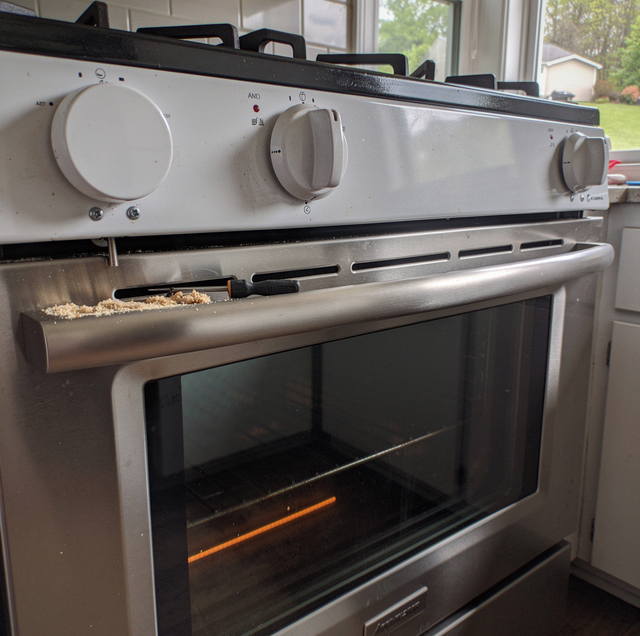
On a gas oven with a glow-bar igniter, the igniter and the safety valve work as one electrical circuit. When the oven calls for heat, the control sends power through the igniter and, in series with it, through a small heater inside the valve. The igniter warms, its resistance falls, and the current climbs. Inside the valve, the rising current heats a bimetal strip until it bends far enough to open a port, allowing gas to reach the burner, where the hot igniter lights it. The valve opens only when enough current flows, so a weak igniter and a failed valve can both leave you with a cold oven and no flame. From the outside, the two faults look the same, which is why the visible symptom matters. Each symptom you might notice narrows the cause in its own way:
| What you see | Where it can lead |
|---|---|
| The igniter glows, but no flame appears | A weak igniter that glows without passing enough current to open the valve, or a valve that will not open |
| The igniter never glows at all | No power reaching the circuit from the control or its wiring, or a break somewhere in the circuit |
| The flame lights late with a soft whoomp | An igniter slow to reach opening current, delaying the valve |
| Bake fails but broil works | The bake igniter, or the bake side of the valve, on that circuit alone |
| The oven lights, then goes out and stays cold | A connection or part losing the circuit once it heats |
| The oven heats, but slowly | A heating-rate question rather than an ignition failure |
Why a Glowing Igniter Can Still Be the Failed Part
The glow is the part of this system you can see, and it misleads people. An igniter that glows looks like it is working, so the natural conclusion is that the gas valve must be the problem. That conclusion can be wrong.
A glow bar ages with use. The ceramic element inside it slowly changes, and its resistance at full heat creeps upward. Higher resistance means less current in the circuit. Because the valve is wired in series with the igniter, the valve's heater receives only what the igniter lets through. A worn igniter can reach a temperature high enough to see through the slots in the oven floor and still not carry the current the valve needs to swing open. The result is an igniter that glows steadily, a valve that stays shut, and an oven that never warms.
This is the fault that leads people to order the wrong part. A glow proves the igniter is getting power. It does not prove that the igniter is drawing enough current to do its second job: holding the valve open. Brightness alone cannot settle it, because the eye cannot read current, and a worn igniter can glow as visibly as a healthy one.
Clues That Shift Suspicion to the Valve
A failed valve produces the same initial symptom: the igniter glows, but nothing lights. What separates the two is found in the circuit, not in the view through the floor slots. If the igniter is drawing full current and the valve still does not open, the valve's internal heater, its bimetal strip, or the port it controls has failed.
A few observations help frame that question before anyone takes the oven apart. If the cooktop burners light as they should, gas is reaching the range, and the fault sits inside the oven's own circuit rather than in the supply. If a new igniter was fitted recently and the symptom returned unchanged, the valve moves up the list. And on ovens with separate bake and broil burners, the pattern between the two can narrow it further, which the section on bake and broil covers.
The valve is also the part that should never be forced. It is the component that keeps gas from flowing into a cold cavity with nothing to light it. Any attempt to hold it open, bypass it, or light the burner by hand defeats the one safeguard that stands between a failed igniter and a room full of gas.
When the Igniter Stays Dark
An igniter that never glows tells a different story from one that glows without lighting. Because the igniter and the valve heater share a single series circuit, a break anywhere in that loop stops current from flowing through both. The igniter itself may have burned open or cracked through. The valve's internal heater may have failed open, which also leaves the igniter dark even though the igniter is fine. A wire may have come loose at a terminal, or its insulation may have cooked through behind the oven. Or the control may never be sending power in the first place, from a failed relay on the board or a selector switch that is not closing.
That list covers both the igniter and the valve, so a dark igniter does not clear the valve. It only tells a technician that current is not completing the loop, and which of those links is open has to be found by testing each one with the power off.
Before any parts diagnosis, check the two things that are yours: that the breaker feeding the range is on and that the clock or display is lit. A gas oven with hot-surface ignition still needs household power for every bake.
Why a Late, Loud Light Needs Attention
A soft whoomp when the bake burner finally catches means gas reached the burner before a steady flame did. On a hot-surface system, this can come from an igniter that is nearing the end of its useful life. It reaches the opening current slowly; the valve opens partway, and gas begins to flow before the igniter is hot enough to light it cleanly. A burner whose ports are partly blocked can add to it, because the flame then spreads unevenly across the burner.
A delayed ignition releases a flash of burning gas inside a closed oven cavity, and each new attempt repeats that flash. Once the oven lights late with a thump, the igniter and valve circuit belong to a technician.
Any gas smell calls for the same caution. If you smell gas, leave the house without touching switches or appliances, and call the gas utility from outside. If a carbon monoxide alarm sounds, get everyone out first and call from outside.
Bake Versus Broil as a Clue
On ovens that have a separate broil burner at the top of the cavity, the two burners can help each other's diagnosis. Each burner has its own igniter. Some of these ovens feed both burners from one dual safety valve, a single body with two outlets, where each outlet opens on its own heater circuit wired to its own igniter.
That layout makes the comparison useful. If broil lights as it should and bake stays cold, the gas supply, the valve body's inlet, and the control's ability to call for heat are all doing their jobs. The fault then sits with the bake igniter or the bake side of the valve. If neither burner lights, the search moves toward what the two share: the control, the power feeding the range, or the valve body as a whole.
Not every oven is built this way. Some single-burner ovens broil by running the same bottom burner, and some ranges use a separate single valve for each burner. Whether the comparison applies depends on the layout inside your model.
When the Flame Lights and Then Quits
An oven that lights, burns briefly, and then goes out while the cavity is still cold has a circuit that works at first but fails once it warms up. A connector at the igniter or valve terminal can lose contact as the surrounding metal heats. A cracked igniter can hold together cold and separate as it expands, cutting the current and letting the valve close. On ovens that use spark ignition instead of a glow bar, the flame-sensing side of the system can shut off the gas when it no longer sees a flame; the spark system, with its clicking and electrode, behaves differently from the glow bar described here.
A slow preheat is a separate question from ignition. When the burner lights and stays lit but the oven takes too long to reach temperature or bakes unevenly, the causes sit with heat output and temperature control rather than with the igniter and valve.
How a Technician Confirms the Fault and Replaces the Part
The confirmation starts with power disconnected and the appliance gas valve closed before any panel comes off. That order protects against both line voltage and fuel. From there, the diagnosis is a measurement rather than a guess. The technician checks the current the igniter draws once it is hot, with power restored for that reading, against what that valve needs to open, and checks the valve's internal heater circuit for continuity. Those two readings distinguish between a weak igniter and a failed valve.
On an oven with a bottom bake burner, the igniter sits beside that burner under the oven floor panel, and the valve sits near the gas inlet at the back or bottom of the range. Reaching either part means placing hands beside the gas line and the line-voltage wiring, and replacing a valve requires breaking and remaking gas connections, followed by a leak check on every fitting that was disturbed. Neither part is a homeowner job. After the repair, the oven is run through a bake cycle to confirm a clean, prompt light and a steady flame.
Frequently Asked Questions
No. The heating element is a brittle ceramic, and brushing or scraping it can crack it. The loss of current that causes a worn igniter to fail comes from changes within the material itself, not from grime on its surface, so cleaning cannot restore it.
Not one with hot-surface ignition. The safety valve opens only while current flows through its heater, so with the power out, the valve stays shut, and no gas reaches the burner. Holding a match to the burner accomplishes nothing and puts your hand inside the cavity. Once power returns, the oven lights via the same igniter and valve sequence as before.
Yes. Once the oven reaches the set temperature, the control cuts power to the igniter circuit, the valve closes, and the flame goes out. When the temperature drops, the control calls for heat again and the igniter warms up to relight the burner. A flame that goes out and returns while the oven holds temperature is normal cycling.
Yes. The igniter and valve are paired by their current: the valve is built to open at a specific current, and the igniter is chosen to deliver it. An igniter with the wrong rating can glow brightly and still never open the valve, or can push current through the valve heater that it was not designed to carry. Igniters also differ in shape and mounting, so the part is matched to the model.
A healthy bake flame burns blue and holds a steady shape along the burner. A lazy yellow flame, or soot on the burner or the oven walls, is a sign the gas is not burning cleanly. Causes include a misadjusted air shutter, a dirty burner, or an orifice that does not match the fuel the range is running on. That shifts the problem from ignition to combustion, and incomplete combustion produces carbon monoxide. The air shutter, burner, and orifice are checked and corrected by a technician.
No. The shutoff behind the range is a manual valve on the supply line that lets gas reach the appliance at all. The safety valve sits within the range and opens electrically only while the igniter circuit carries enough current. A closed shutoff stops both the cooktop and the oven.
Order gas oven repair for an oven that will not light — igniter and safety-valve circuit testing, with igniter or gas valve assembly replacement. True Appliance Services Inc. serves Maryville, Alcoa, Knoxville. Call (865) 205-8717.