
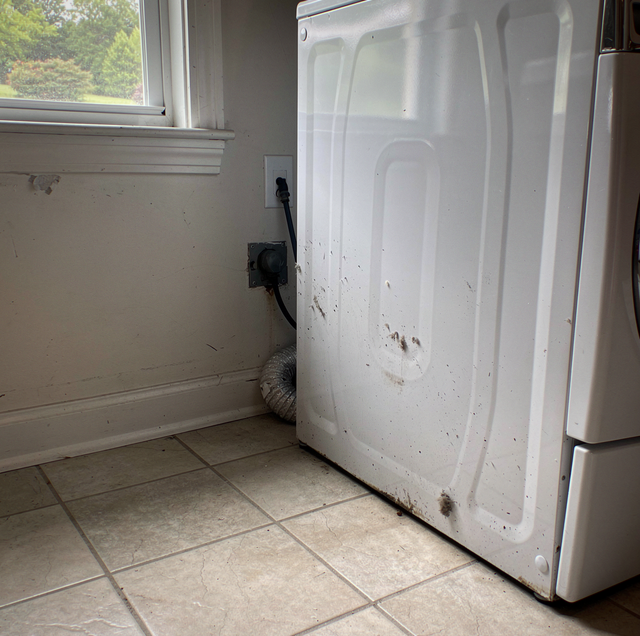
Front-load and top-load washers both support the drum on a bearing that allows the entire assembly to spin freely at extraction speed while carrying the full weight of a wet load. That bearing sits behind a rubber or composite seal that keeps wash water inside the tub and off the bearing itself, and as long as the seal holds, the bearing stays packed in factory grease and spins quietly. Once the seal starts to fail, water works past it into the bearing, washes out the grease, and lets the metal races corrode and pit against each other, and that is where the noise starts. Each symptom below aligns with the part it points to, since a bearing problem sounds different from the handful of other faults often blamed on it.
| What You Hear or See | What It Points To |
|---|---|
| A roar on spin that grows louder as the drum speeds up | Drum bearing wearing behind the tub |
| A rumble when you turn the empty drum by hand, with the washer unplugged | Bearing race already pitted or running dry |
| The drum rocks side to side or front to back when you press on it, with the washer unplugged | Bearing seat or the spider arm that holds it has play |
| Rust streaks or a grease smear at the rear of the outer tub | Seal has already let water past it |
| Water beaded on the back panel or dripping under the machine | Rear tub seal letting water past, once hoses and the drain pump are ruled out |
| Noise that only shows up with a lopsided or single-item load | Suspension or balance issue, not the bearing itself |
How the Bearing and Tub Seal Work Together
A seal sits in front of the drum bearing to keep wash water where it belongs. On a front-load machine, the bearing is pressed into or against the back half of the outer tub, and the seal rides directly against the spinning shaft or hub that connects the drum to that bearing. On a top-load machine, the same relationship exists at the base of the tub, where the drive shaft passes through a seal before it reaches the bearing that lets the basket spin. In both layouts, the seal is the shorter-lived of the two parts, so seal failure is one path to a bad bearing; overloading and age can wear a bearing without any water reaching it. Once water gets past a worn seal, it washes grease away and introduces rust into the bearing's steel races, and pitted metal grinds against pitted metal every time the drum turns, which is the mechanical source of the roar.
The Sound, and How It Differs from a Foreign Object or a Suspension Problem
A worn bearing produces a continuous, low-pitched grinding or roaring sound that scales with drum speed, present throughout the entire spin cycle rather than at any one moment, and it gets worse across multiple loads rather than appearing and disappearing on its own. A foreign object wedged between the drum and the outer tub- a coin, a bra underwire, a button- sounds different: it is a sharper metallic clank or scrape that repeats once per drum rotation at the same point, and it can shift position or fall away entirely, which a true bearing problem never does. A suspension or leveling issue is different again: it appears with an unbalanced or single heavy item in the load, produces a thump or bang against the cabinet or an adjacent wall rather than a grind, and can disappear once the load is redistributed or the machine is releveled. A washer that shakes hard or walks across the floor during spin points first to the suspension and leveling rather than the bearing. A technician checks the shock absorbers, springs, and leveling feet before looking at the drum bearing.
Front-Load vs Top-Load Bearing Layouts
The two designs put the bearing under different kinds of stress. A front-load machine turns its horizontal drum at extraction speeds that can run well above what a top-load unit reaches, and that higher RPM puts more radial load on a single large bearing assembly positioned behind the tub. On some front-load models, the tub is a sealed, welded, or riveted plastic assembly, and on those units the bearing is not sold or replaced as a stand-alone part; the repair path is a new outer tub with the bearing and seal already fitted inside it, rather than pressing a bare bearing into the old tub. A top-load washer carries its bearing at the base of a vertical tub, supporting the basket rather than resisting the same extraction forces a horizontal drum sees, with the drive shaft, seal, and bearing stacked together at that single base point. Lower spin speeds on top-load machines mean less mechanical stress per rotation, but the base seal still fails from the same water-intrusion mechanism as a front-load unit.
What a Bearing Replacement Involves
Reaching the bearing means pulling the drum out of the cabinet, which involves first disconnecting the motor, the suspension or shock mounts, and, on a front-load unit, the door boot and counterweights. A technician checks for both radial play, side-to-side movement in the drum, and axial play, front-to-back movement, since either one points to a worn bearing once a loose spider or shaft bolt is ruled out. On models where the tub is a sealed assembly, replacing just the bearing is not an option; the job becomes a tub-and-bearing unit swap. On models with a serviceable metal tub, the old bearing and seal can be pressed out and new ones pressed back in. Unplug the washer before touching the drum at all, and leave the teardown itself to a technician; it is not a job for a home workbench.
An unsupported drum can shift suddenly once its mounts are disconnected, and its weight is enough to crush a hand or drop onto a foot. A technician keeps the drum blocked and braced through a bearing teardown; leave the cabinet closed.
Repair vs Replace
Whether a bearing and seal job is worth doing on your machine, or whether a new washer makes more sense, comes down to the same age and failure-history questions that decide any appliance repair; the tub type found during the diagnosis, serviceable or sealed, is the part of that answer specific to bearings.
Frequently Asked Questions
No. A washer's drum bearing is a sealed unit packed with grease at the factory, and it has no accessible grease fitting or oil port for routine maintenance. Once water has gotten past the seal and washed that grease out, there's no way to add lubricant back in from outside; the bearing and seal have to come out and be replaced or pressed in fresh.
A worn bearing can rumble at the slower speed the drum turns during the wash and rinse portions of the cycle too, since the drum rotates for agitation as well as for spin, just quieter. That quieter rumble stays masked by the sound of water and the motor until the spin cycle's higher speed exposes it clearly.
Yes. A bearing with enough play lets the inner drum wobble on its shaft, and the drum can start rubbing the outer tub or the rear of the tub wall, scoring or cracking it. On some front-load models, the aluminum spider arm that carries the drum can also crack or corrode through at its shaft. Either one widens the repair beyond the bearing and seal.
It can. Once the races have pitted and lost their grease, a bearing can bind hard enough that the drum drags or will not turn by hand, and the motor may strain, trip its overload protection, or throw an error code before the cycle ends. A drum that suddenly resists a hand turn, checked with the washer unplugged, has passed the noisy stage.
Yes, it can be. A dryer's drum support roller or idler pulley can produce a rumble or squeal that sounds very close to a washer bearing, and because a washer and dryer sit right next to each other, it is easy to blame the wrong machine. Running each appliance alone, one at a time, with the other unplugged or simply not started, isolates which one is making the sound.
Yes. The rubber or composite seal in front of the bearing is a material that ages and can develop micro-cracks over time from ordinary exposure, not only from cycle count, so a washer that sits idle for long stretches is not automatically protected. A washer that sat idle for months gets the same check for rust streaks at the rear of the tub as one run daily.
Bring in a certified technician for washing machine repair on a washer that roars during spin — the bearing and seal are confirmed and distinguished from a stuck object or a suspension fault. True Appliance Services Inc. serves Maryville, Alcoa, Knoxville. Call (865) 205-8717.