
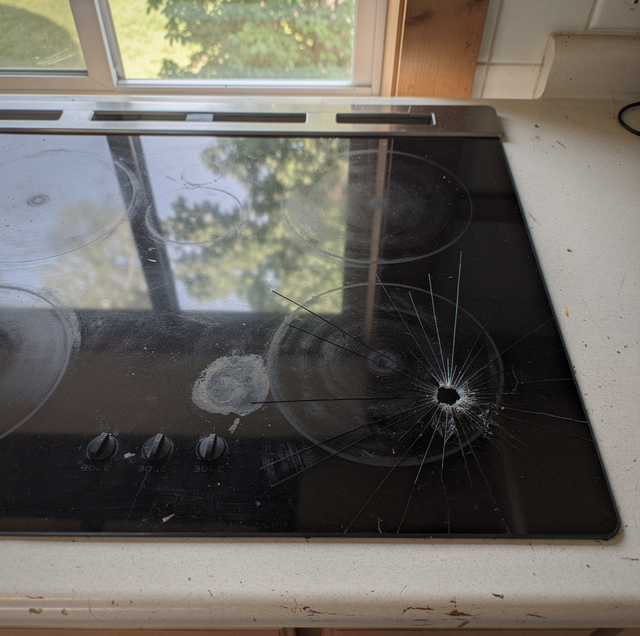
Your cloth catches on a line that was not there this morning, or you hear a sharp tick as the cooktop cools, and a fine crack now runs across a back zone. A smooth top that has handled years of boiling pots can still split, and the reason sits in what the surface is made of and the loads it was not built to take.
Knowing how the crack started helps you avoid a second one on the replacement top, and it gives the technician one more clue about what to check underneath.
How Glass-Ceramic Survives Heat but Not Every Load
The top of a smooth cooktop is glass-ceramic: a glass that is heat-treated after it is formed, causing part of it to grow into tiny crystals. Those crystals give the material a thermal expansion close to zero. When a radiant zone glows red, the glass above it changes size by a tiny amount, so the hot circle and the cooler glass around it do not pull against each other. That is what lets one zone run at full heat while the other is cold.
What glass-ceramic has that ordinary glass lacks is brittleness. It does not bend or dent before it breaks. Glass holds up well when it is squeezed and gives way when it is stretched, and a crack starts at a flaw: a chip, a scratch, a pit, or a rough spot on a cut edge. A blow from above bends the sheet and stretches its underside. An uneven temperature inside the sheet causes the cooler glass next to the hotter glass to stretch. A frame that pinches the edge stretches the glass beside the pinch. The causes below come down to one of those loads meeting a weak point.
Under the glass, radiant coils or halogen lamps heat the zones, and each zone has a limiter that switches its element off when the glass gets too hot. On an induction cooktop, the coil heats the pan, and the glass warms from the pan's base. The controls protect the glass from its own heat source, not from what sits on top of it.
Cold, Wet or Spilled Items on a Hot Zone
Expansion close to zero still leaves some. Set a frozen package, a cold wet pan, or a dripping sponge on a zone that has just been at full heat, and the glass under it cools in seconds while the glass around it stays hot. A pot boiling over pours cooler liquid across a hot ring in the same way. The cooled patch shrinks slightly against hot glass that does not, and the edge of that patch is stretched.
On sound glass, the material is built to ride that out, and a cold spill can leave nothing behind but a mess. On glass that already carries a chip, a deep scratch or a pit inside the zone, the same stretch lands on a ready-made starting point, and a crack can run from it in a moment. That is how a top can take boil-overs for years and then crack on an ordinary one: the flaw arrived first, and the cold was the last load.
So frozen food goes into a pan rather than onto the glass, a pot boiling over has its heat turned down first, and wet wiping waits until the zone has cooled.
Impacts, Point Loads and the Scratches That Start Cracks
A dropped cast-iron lid, a falling jar, or a heavy pot set down hard on its rim puts a large force on a spot the size of a coin. The glass beneath that spot flexes downward for an instant, and its underside stretches. If the stretch is enough, the break starts under the point of contact and runs outward in several directions at once. The glass can also survive the blow with a small chip, which becomes the flaw a later load opens.
Weight on a small area does the same thing slowly: a knee on the glass while someone reaches a high cabinet, or a heavy stockpot resting on a raised rim or a wire trivet.
Scratches are the quieter route. Sliding a pan with a gritty or rough base across the glass cuts fine grooves. One scratch is cosmetic. A surface worn with them has flaws running in every direction, and any of the other loads in this article can use one as its starting point.
Overhanging Pans and Warped Pan Bases
A zone is laid out for a pan that covers it and sits flat on it.
Overhang: A pan much wider than its zone holds heat against glass outside the heated circle, and near the front or side of the cooktop it holds that heat against the edge and the trim. The glass under the overhang is heated from above while the glass beside it stays cool, which puts a temperature difference where the zone was not laid out to have one. Manufacturers set a limit on how far a pan may extend past a zone for this reason, and the figure for your model is in its use-and-care instructions.
Warped base: A pan whose base has bowed, from heating empty or from being plunged into cold water while hot, touches the glass on a ring or at one high spot. Heat that a flat base would carry off stays in the glass, so the zone climbs to its limiter and holds there. A pan that rocks on its high spot also puts its full weight, and every stir, on that one point. That makes it a slow point load on glass already held at its limiter.
Check a pan before its first use on glass. Turn it upside down, lay a straightedge across the base, and look for daylight under the middle. A base that shows a gap will not sit flat on a zone.
A pan left to boil dry takes a related route. With nothing inside to draw heat away, pan and glass climb together, and an aluminum or enameled base can soften and bond to the surface.
Sugar and Melted Plastic Fused to the Surface
Sugar is a spill that manufacturers' care instructions name on its own. Syrup, jam, candy or a sweet sauce that boils over onto a hot zone melts, bonds to the glass, and shrinks at a different rate from the glass under it as it cools. When it lets go, it can take a shallow flake off the surface and leave a pit. The same instructions direct that sugary spills come off while the zone is still hot.
Melted plastic behaves similarly. A bread bag or spatula left in a warm zone fuses to the glass, and pulling it free once hardened can lift the surface along.
A fused patch does damage twice. While it sits in the zone, it heats differently from the clear glass around it, so every use of that zone creates an uneven temperature across the spot. When it comes off, the pit it leaves is a flaw waiting for the next load. If a zone that once carried a fused spill later cracks, tell the technician about that spill.
Stress at the Edge and the Mounting
Cutting and grinding leave fine flaws along the edge of the sheet that the flat face does not carry. On a freestanding range, the glass rests on the top frame. On a built-in cooktop, it sits in a cutout in the counter, on a gasket or in a trim ring, held by clamps or brackets underneath.
Each of those supports can pinch. A cutout that is out of level or out of square, a clamp tightened unevenly, a missing length of gasket that lets glass sit on bare metal or stone, or a range that is not level on the floor loads one part of the edge while the rest sits free. Every heat cycle then works the glass against that pinch. A pot handle swung into the front edge, or a tool that clipped the glass during installation, can also leave an edge chip that sits unnoticed until a crack runs in from it.
Reading the Shape of a Crack
A crack keeps a record of where it began. None of these readings is proof, and a technician weighs the pans, the mounting, and the zone before settling on a cause, but the shape narrows the list.
| Crack pattern | Where it begins | One possible source | Another possibility |
|---|---|---|---|
| Hairline running in from an edge | At the rim of the glass, near a corner or a clamp | Pinching from the frame, cutout or clamps | A knock to the edge that left a chip |
| Star or web of lines from one spot | A single point, sometimes with a chip at its center | An impact or a heavy point load | A deep pit that failed under heat |
| Line through or around a zone | Inside a heated circle or along its rim | An uneven temperature: a cold spill, a fused patch, a warped or dry-boiled pan | A scratch or pit in the zone that gave the stress its start |
Look closely at the start of the crack before anything is cleaned. A chip, a pit, or a fused spot at the origin is the evidence, and scrubbing around it can remove what the technician needs to see.
When the Top Is Replaced Instead of Repaired
Once glass-ceramic has cracked through, the glass is replaced. No repair rejoins it with the strength a cooking surface needs, and a crack in a sheet that heats and cools daily stays ready for the next load.
What stays repairable is everything around the glass. When the top is changed, the technician checks the elements beneath the crack, since a spill that runs through the break can reach an element, its wiring, and then the limiters and switches. The new top goes into a mounting that sits level and even, so whatever pinched the old edge does not pinch the new one. Whether a new top makes sense on an older range is the same repair-or-replace call any appliance gets, weighed on its age and the condition of the rest of it.
Switch a cracked cooktop off at the breaker and leave every zone unused, including those away from the crack. Spills can reach live wiring through the break, and hot glass can split apart under a pan; a technician takes it from there.
A knob turned to off can be bumped, which is why the breaker is used. On a range, the same breaker also powers the oven below it, so plan on the oven being out of use until the top is replaced.
Frequently Asked Questions
Not quite. Gray or silvery lines that wipe away with a cooktop cleaner are metal left by aluminum or copper pan bases and do no harm. A groove you can feel with a fingernail is a true scratch: it is not a crack, but it is a flaw a later load can start one from.
They can cause harm rather than prevent it while the zones are in use. Makers' use-and-care instructions warn against leaving mats, covers or foil on the glass during cooking, because they trap heat against the surface and can melt onto it. A rigid cover on a cold, switched-off top does not affect how much heat the glass can take in, and it is removed before any zone is turned on.
In the manuals that give a figure, the limit sits between about half an inch and an inch past the edge of the zone, and the canner needs a flat base. Check your own model's instructions before a canning day.
Yes. The indicator stays on after a zone is switched off and goes out once the glass has dropped below the temperature the maker treats as a hot surface. Waiting for it before wet wiping keeps a cold cloth off hot glass.
A single-edge razor scraper, held at about a 45-degree angle, with an oven mitt on the hand that holds it while the zone is still warm. Abrasive pads and scouring powders cut fine scratches into the surface and are left in the cupboard.
It depends on the model. On some ranges and cooktops, the glass is bonded to its frame or trim as a single assembly, and on others, the glass is fitted separately. The model and serial number decide which part is ordered, so have them ready when you call.
Have the cracked top inspected and replaced — a technician checks the elements and wiring under the break and sets the new glass level in its mounting. True Appliance Services Inc. serves Maryville, Alcoa, Knoxville. Call (865) 205-8717.