
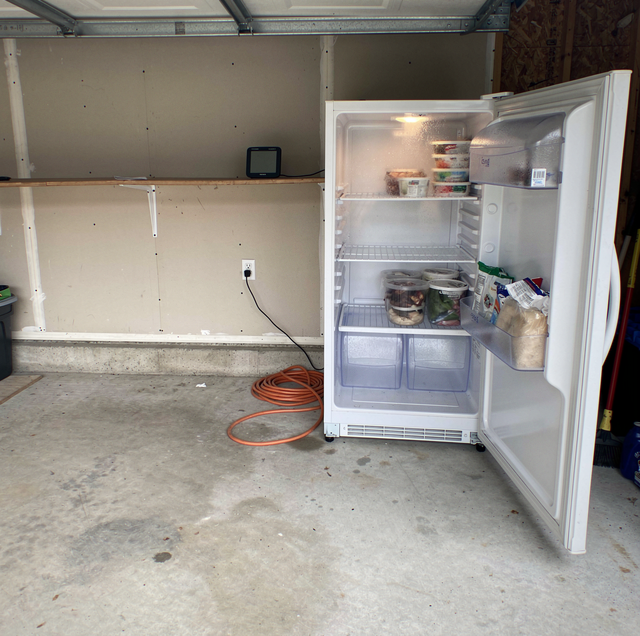
You have probably heard that your garage is the kindest spot in your house for your spare freezer, since the colder the air around your cabinet, the less work your compressor has to do to keep your food frozen. Every winter that idea costs you a freezer full of your groceries.
Your freezer never measures your food. It measures the air touching your thermostat, and once your garage falls below the temperature you set the dial to hold, your appliance hears no request for cooling at all. Your compressor stays silent, your fans stay still, and you find out weeks later when you open your lid, and your top layer gives under your thumb.
The Symptom Looks Exactly Like a Dead Appliance
The picture is consistent enough to be almost a signature. Ice cream has gone soft in the tub, packages that should be solid give under a thumb, and no ice crystals are left anywhere in the load. The light still comes on when the lid opens. The dial sits where it has always sat. Nothing rattles, nothing smells burnt, and no display is flashing a fault code at anybody.
What stands out, once you think back, is the silence. A freezer in a warm kitchen announces itself several times an hour, and you stop registering the sound entirely within a week or two of owning it. Out in a cold garage, the same cabinet can sit for days without making a sound, and because a healthy freezer also goes quiet between cycles, nothing about that silence registers as wrong until the food gives it away.
What Idles a Healthy Compressor in a Cold Garage?
A freezer's thermostat does not sense the food or the cabinet walls. It senses air, and the air inside the compartment stays in constant exchange with the room through the insulation and around the door seal. Park that cabinet in a room already colder than the number on the dial, and the sensing element finds a compartment sitting at or below the temperature it was asked to hold. From its side of the circuit, the job is finished before it begins.
The threshold for refrigerator and freezer use in a garage or basement comes down to one sentence: below about 25 degrees F, the thermostat will keep the unit off since it never detects the need to run the compressor. Read that slowly, because every word of it is about a thermostat and none of it is about a compressor. The motor does not fail, does not overheat, and does not trip anything.
The distinction matters more than it sounds, because a compressor that will not start is a familiar repair with familiar causes: a failed start relay, a seized motor, a control board that has lost its output. Those faults break a component. This one breaks nothing at all. Every piece inside the cabinet remains capable of doing its work, and the chain of events that would normally set that work going stops at the very first link, where a thermostat compares two temperatures and finds no gap between them worth acting on.
Why the Fridge Side Goes Warm While the Freezer Stays Cold
If the appliance out in the garage is a combination refrigerator-freezer rather than a stand-alone chest or upright, a cold room produces a result that looks backward to anyone watching it happen. The freezer compartment holds its food perfectly. The refrigerator compartment does not.
Here's the reason: the freezing cold room would keep the freezer food frozen, but since the compressor is always off, the circulation fans never come on, and the refrigerator section would not receive any cooling. Most combination units give the fresh-food side no cold source of its own. It draws air from the evaporator coil, which has already chilled it, and a fan pushes that air up through a duct into the upper compartment.
Stop the call for cooling, and you stop the fan along with it. The freezer half coasts along on the room, which happens to be cold enough to do the job by accident, while the refrigerator half drifts up toward whatever the garage happens to be that week, with milk, eggs, and leftovers sitting inside it.
The Window a Freezer Is Built to Work In
The ambient operating range for these units is narrower than most owners assume: refrigerators of this kind are designed to operate in environments from 55 to 80 degrees F, and operating one outside that range can cause improper operation and excessive energy use. An unheated garage in January sits far below that floor, and the same garage in August often sits well above its ceiling.
The hot direction fails loudly. Above the window, the compartment never quite reaches its set point, so the compressor runs almost without pause, the cabinet is warm to stand beside, and the power bill climbs all summer. The cold direction fails silently, and silence is the reason it runs for weeks before anybody notices anything at all.
A room at 20 degrees will hold frozen food perfectly well while the compressor sleeps through the cold snap. A room hovering near 35 will not, and the thermostat may still decline to run, because it compares the compartment against a set point, not against a food-safety threshold. The number that matters is specific: a free-standing freezer should be set at 0 °F or below for long-term storage of frozen foods. A garage freezer is free-standing.
What You Can Settle Yourself, and Where It Stops
Put a thermometer inside the compartment and read it after a few hours. That single number separates a freezer coasting safely in a cold room from one that has drifted warm, and it speaks for the food instead of for the room. Then check the load itself against the food-safety threshold that covers this exact moment.
The food question comes down to this: if food is partly frozen, still has ice crystals, or is as cold as it would be in a refrigerator at 40 °F, it is safe to refreeze or use, and it is not necessary to cook raw foods before refreezing. Discard foods that have been warmer than 40 °F for more than two hours. Ice crystals are the thing to look for, and they resolve the question faster than any guess about how long the cabinet has been quiet.
From there, the fix is more often a placement question than a parts question: move the cabinet into conditioned space, or replace it with a model built for a wide ambient temperature range. If the room sits comfortably within the unit's ambient window and the compressor still doesn't run, a trained technician takes it from there with meters. Either way, what failed in a cold garage is usually not a broken part at all, but a working part that never got the signal to start.
Leave the rear service panel closed and have an appliance technician test the start relay and compressor terminals, which sit at line voltage beside sealed refrigerant tubing.
Frequently Asked Questions
Not reliably. A colder set point makes the thermostat call for cooling sooner, so it can help you in a garage that only dips a little. Once your room drops below the unit's ambient range, the freezer sits outside its own design conditions.
A thermometer that stores the minimum and maximum readings gives you the full range you missed. Freeze a small cup of water, set a coin on top, and leave it in the compartment; if you come back to the coin resting at the bottom, the load thawed and refroze while you were gone.
Yes, because both sense room-influenced air through a thermostat and both sit in the cold room you worry about. A chest freezer holds its cold longer once the compressor stops, since opening the lid spills less air than swinging your door, so your load may ride out a short snap better.
Quite possibly, and your compartment thermometer will tell you. Food kept solidly frozen by a cold room is still frozen food. What that room cannot promise you is a steady temperature, so a single warm afternoon can quietly lift the load without the compressor ever waking up to catch it.
It solves the cold half. Bringing the room up inside the unit's ambient window lets the thermostat behave normally again, but a garage that swings tens of degrees across a day still puts your freezer through far wider cycling than your kitchen does, and next summer that same room will swing the other way, past the top of that same range.
At that point the room itself has been ruled out, so the question moves inside your cabinet. A technician's inspection covers insulation, airflow, and thermostat calibration, and a professional diagnosis involves checking refrigerant levels, testing temperature controls, and inspecting the defrost system. That order matters to you because it separates a control fault, which is a single part swap, from a sealed-system fault, which is a far larger repair, before anybody orders a component or quotes you for the repair work.
Book a freezer diagnostic for a unit that has gone quiet in an unheated garage — get the thermostat, start relay, and sealed system checked by a technician who repairs garage freezers every winter. True Appliance Services Inc. serves Maryville, Alcoa, Knoxville. Call (865) 205-8717.