
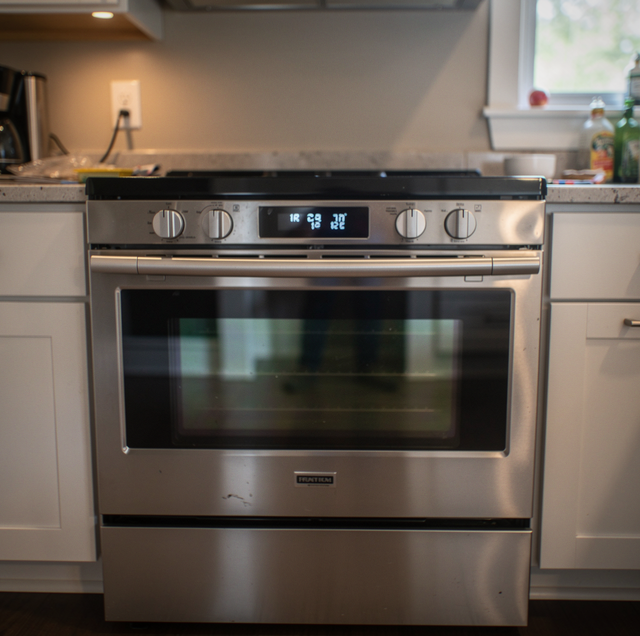
You set the self-clean cycle running after dinner, your kitchen got hot, and by morning the oven had gone quiet. Now nothing you press on the panel does anything. The door will not open, the display is dark, or the top burners still work while the cavity below them stays cold.
It is a common hour to lose faith in an appliance, and it is also the hour when an oven is most likely to be doing what it was built to do. Some of what you are looking at belongs to the cycle and clears on its own. Some of it is a fault and will not. Telling the two apart before you pick up the phone is well worth your time.
The Hottest Thing an Oven Ever Does to the Inside of Itself
A self-clean cycle is not a wash. The cycle uses very high temperatures, burning soil to a powdery ash — check your owner's manual for specific instructions on how to set the feature. Every surface, coating, and fastener inside the cavity takes that heat for as long as the cycle runs, and so does everything mounted behind them.
How hard that heat has to work is not fixed, and a household changes it by how much soil the cavity holds. An oven runs best when self-cleaned before it becomes heavily soiled, because heavy soil results in longer cleaning and more smoke, so wipe out loose soil and remove any foil first. A cavity carrying a year of boil-overs and spills gives the cycle more to burn, so it runs longer and puts more smoke into the room than the same model would after a lighter month of cooking. A self-clean cycle runs 2.5 to 4.5 hours on a range, 2-4 or longer in a wall oven.
That is worth holding on to while you stare at a dead panel, because the cycle your oven has just finished was not the standard one out of the manual. It was the one your own kitchen handed it, built out of how full the cavity was and how long the heat had to keep going before the last of the soil was gone.
The Door Stays Locked
The lock runs on its own timer, and it engages long before anything inside gets hot. The oven door locks approximately 6 seconds after the cycle starts, and Heat, On, Locked, and Clean all appear on the display while the cycle runs. None of that sequence waits on a switch you can reach from the kitchen floor, and no amount of pressing at the panel brings the latch back early.
The end of the cycle costs people the most patience. The door will not release until the oven cools, and the cycle time includes a 30-minute cool-down period; when the cycle is complete, and the oven cools, End appears on the display and Locked disappears. An oven still shut half an hour after the noise stopped is a hot cavity running out its own clock, and it opens when the clock says so.
What Makes an Oven Look Dead as Soon as the Cycle Has Ended?
Set the lock aside, and the accounts people give of a dead oven fall into three shapes. The oven takes a setting and never warms at all. The display is dark or frozen, and no button on the panel changes it. Or the oven heats and bakes nothing the way it did a week ago, running cold or drifting to either side of the number you asked for.
That third shape has a known set of causes. Inaccurate or fluctuating oven temperatures can result from damaged temperature sensors, worn-out thermostats, or control panel malfunctions. An oven that does not reach the set temperature or heats excessively needs a professional diagnosis. Which of those is not visible from the front of an oven?
So the honest position after a bad cycle is that you have a symptom and not a diagnosis. What you can do is describe that symptom exactly. A dead panel, a cavity that never warms, and an oven running cold are three different jobs, and the part that has to come off the van differs for each of the three.
Discoloring, Hairline Cracks and the Popping Sounds That Come With the Heat
Open the door on a finished cycle, and the inside can look worse than it did going in. The heating and cooling of porcelain on steel in the oven may result in discoloration, loss of gloss, hairline cracks, and popping sounds; this is normal and will not affect the appliance's performance.
So a floor gone dull, a fine crack in the enamel, or a bang out of the cavity while it cooled overnight is not the reason your oven stopped working. The cosmetic change and the fault turned up on the same morning, without one causing the other.
Smoke, Soil and the Oven Vent That Has to Stay Clear Throughout
The cycle needs a path for its own air. The oven vent or vents should not be blocked during the self-cleaning cycle, because air must be able to move freely. On most ranges, that vent sits under a rear trim strip or below one of the rear surface elements, which is precisely where a kettle, a roasting pan, or a folded towel tends to end up between meals.
The room needs a path too. Keep the kitchen well-ventilated during the cycle to help eliminate heat, odors, and smoke. A hood on its highest setting and a window open at the far end of the room carry that air outside instead of around the house, and a cycle left to run behind a shut kitchen door does the opposite.
The Parts a Technician Tests After a Cleaning Cycle That Ended Badly
The visit has a defined shape: inspecting elements, igniters, thermostats, sensors, wiring, and controls to pinpoint the exact cause, then recalibrating or replacing thermostat sensors, control boards, or wiring to restore proper operation. That work covers freestanding ranges, wall ovens, cooktops and combo units, which matters here because a wall oven and a freestanding range keep those parts in quite different places.
A technician cuts power at the breaker before an oven's back panel comes off, because the sensors, control boards and wiring behind that panel sit alongside its line-voltage terminals.
That list belongs to a visit rather than to a free Saturday, and the reason is the place those parts live. Sensors, boards and wiring sit behind the back of the appliance, on the far side of a panel that is also the barrier between you and the supply feeding it. An electric range draws from its own dedicated circuit, and a gas range has a fuel line run up to it, and neither of those goes quiet because the oven has been dead since morning.
What you can do is make the visit short. Have the model and serial plate to hand, which on most ranges sits on the frame behind the door, and be ready to say when the cycle ran, how long the door stayed shut afterwards, and what the oven has done since. The cycle itself lasted an afternoon; the sensors and boards it heated have been working for years, and the visit sorts out which of those two spans has now ended.
Frequently Asked Questions
Remove your oven racks, broiler pan, grid, cookware, and bakeware before a high-temperature cycle, and take any foil out too. Treat that as part of starting your cycle, and do it while the cavity is still cool enough for you to reach.
Soil on your glass before you started is the usual reason. Soil left on glass before self-cleaning may leave dark streaks or stains; most of these stains can be removed with a glass cleaner and a fine steel wool pad, and cleaning your window first reduces burned-on residue.
Some odor is expected at first. Keep your kitchen well-ventilated during the cycle to help eliminate heat, odors, and smoke. If you can still smell it once your oven is cool and wiped out, treat a persistent smell after a cleaning cycle as a possible malfunction worth a call.
Remove any plastic items from the cooktop to prevent melting, and clear all items out of the storage drawer. Utensils, pots, cutting boards, and bag clips live on your cooktop, and baking sheets live in the drawer under it, so give both of them a look before you press start on your next cycle.
Make sure the door is completely closed before self-cleaning; otherwise, it will not lock, and the cycle will not begin. A door held a hair off its seat by a rack corner, or a sheet of foil, gives you a cycle that never ran at all, and an oven that appears to have ignored you can turn out to be one you never started.
Not in the same room, and this one is specific. The health of some birds is extremely sensitive to the fumes given off during a self-cleaning cycle; exposure to the fumes may result in the death of certain birds, and birds should always be moved to another closed and well-ventilated room. Plan your move before your cycle starts, because the door locks within seconds of your pressing start and the oven then keeps its own schedule until it has cooled, and you cannot shorten that from the outside.
Book an oven and stove repair visit — a dead oven after a self-clean cycle needs its sensors, control boards and wiring checked behind the panel, and that is a technician's work. True Appliance Services Inc. serves Maryville, Alcoa, and Knoxville. Call (865) 205-8717.