
Why Your Range Hood Suddenly Stopped Pulling Air
You turn the range hood on high while searing something on the stove, and instead of the usual pull that clears smoke and steam within seconds, the air just sits there, maybe drifting toward the fan but never really leaving the kitchen. The motor is running. The fan blades are spinning. Something between the stove and the outside wall is simply not letting air move the way it should, and figuring out where takes working through the system in the order air actually travels.
How a Range Hood Is Supposed to Move Air
A range hood pulls smoke, steam, and grease-laden air up through a filter, across a spinning fan, and out through ductwork to either the outside of the house or, on a recirculating model, back through a charcoal filter into the kitchen. Every one of those stages can restrict airflow, and because they sit in a line, a blockage anywhere in the chain reduces suction at the stove even if the rest of the system is perfectly clear. The fan's rated capacity, measured in cubic feet per minute, only means anything if the path from the stove to the outside air is actually open enough to let that much air through.
The Grease Filter Is the First and Most Common Blockage
Sitting directly under the hood, the metal filter (either a mesh screen or a baffle-style filter with angled slats) catches airborne grease before it can reach the fan and duct. Over weeks of regular cooking, that filter loads up with a sticky grease film that narrows the openings air has to pass through, and a heavily clogged filter can cut airflow dramatically even while the fan motor runs at full speed. Mesh filters clog faster than baffle filters because their fine screen has far more surface area for grease to cling to, which is one reason many newer hood designs have shifted to baffle-style filters that are both more effective at trapping grease and easier to keep clear.
Ducted vs. Recirculating Changes Where to Look Next
A ducted range hood pushes air through metal ductwork to a vent cap on an exterior wall or the roof, and every foot of that duct run, plus every bend, adds resistance the fan has to overcome. A recirculating range hood, sometimes called a ductless model, skips the exterior venting entirely and instead runs the exhaust air back through a charcoal or carbon filter that absorbs odor before releasing the air back into the kitchen; that charcoal filter has to be replaced periodically, since it does not clean itself the way a metal grease filter can be washed, and a saturated charcoal filter restricts airflow even though it looks intact.
Duct Blockages Cut Suction Even With a Clean Filter
If the grease filter is clean and suction is still weak on a ducted hood, the restriction has moved further down the line. A kinked or crushed section of flexible duct behind the cabinet or in the wall cavity narrows the path, much like a kinked garden hose restricts water flow. Grease and dust build up along the interior walls of the duct over years of cooking, gradually narrowing the effective diameter even in a straight, uncrushed run. And the exterior vent cap, the flap or louvered cover on the outside wall or roof where air actually exits the house, can become clogged with grease residue, dust, or in warmer months an actual bird's nest, blocking the exhaust from the outside in even when the entire duct run inside the house is clear.
The Damper Can Stick Shut
Many range hood duct systems include a backdraft damper, a spring-loaded flap positioned where the duct meets the vent cap, whose job is to let exhaust air out while blocking outside air, cold drafts, insects, and even backdrafting from other exhaust appliances from coming back in when the hood is off. Grease residue and dust can gum up that spring hinge over time, and a damper that has partially stuck closed acts as a permanent restriction, reducing airflow even when everything else in the system is functioning normally.
Duct Length and Bends Matter More Than People Expect
Every 90-degree bend in a duct run adds resistance roughly equivalent to several feet of straight duct, and a range hood vented through a long run with multiple turns needs meaningfully more fan capacity than one with a short, straight shot to an exterior wall. A hood installed with an undersized fan for its actual duct configuration will always feel weak, even brand new, which is a design mismatch rather than a maintenance issue, and it is worth knowing that distinction before assuming something has failed.
What You Can Check Yourself
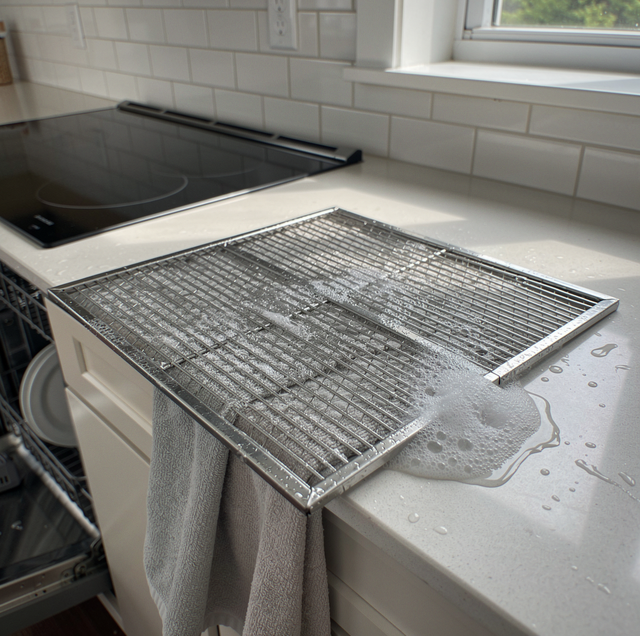
Remove the grease filter (most simply unclip or slide out) and either hand-wash it in hot, soapy water or run it through the dishwasher if the manufacturer allows it, since a degreased filter alone resolves a large share of weak-suction complaints. Step outside, if the duct terminates on an exterior wall, and confirm the vent cap's flap opens fully and air is visibly moving when the hood runs on high; a flap that barely moves points to a blockage further down the duct or a stuck damper. On a recirculating model, check the manufacturer's replacement schedule for the charcoal filter, since that filter has a fixed service life and cannot be cleaned like the metal grease filter.
When It's a Duct or Motor Problem, Not a Filter Problem
If a freshly cleaned filter and a confirmed-clear exterior vent still leave you with weak suction, the restriction is likely inside the duct run itself, somewhere a homeowner cannot easily inspect without opening a wall or ceiling cavity, or the fan motor's bearings have worn enough that the blades are no longer moving air efficiently even while spinning. A motor that sounds louder or rougher than it used to, even without a change in airflow yet, is often an early warning sign that bearing wear has begun before suction noticeably drops.
Frequently Asked Questions
At least once a year, ideally before and after the season when birds are most likely to nest in an exterior vent opening, since that blockage happens from the outside and gives no warning inside the kitchen until suction has already dropped noticeably.
Yes, though it is less common than being underpowered. An oversized fan pushing air through an undersized or overly restrictive duct run can create enough back-pressure to strain the motor and cause excess noise, so duct sizing needs to match the fan's rated CFM in both directions, not just be "as big as possible."
Yes. Grease residue that accumulates along duct walls over years of cooking is combustible, and a kitchen fire that reaches the hood can travel through a grease-lined duct in a way it would not through a clean one, which is one of the practical reasons duct interiors deserve attention beyond just airflow performance.
This pattern often points to a duct or vent restriction rather than a filter or motor problem, since the restriction has more effect as the fan tries to move a larger volume of air, and a low-speed setting may simply not demand enough airflow to expose the bottleneck the way high speed does.
Sometimes, if the cabinet layout and an accessible path to an exterior wall or roof allow it, but it usually requires cutting new ductwork and a vent cap opening in the wall or roof, which is a construction project rather than an appliance repair. That kind of retrofit falls outside an ordinary hood repair or service call and is better scoped with a contractor who handles exterior venting work, rather than assumed to be a simple filter-swap-style fix.
Yes, and often more so, since an over-the-range microwave's built-in vent fan uses a smaller filter and narrower internal duct path than a dedicated range hood, meaning grease buildup restricts its already-limited airflow faster than it would in a larger standalone unit.
A range hood rarely loses suction all at once. It is nearly always a slow accumulation, grease narrowing the filter, dust narrowing the duct, a damper hinge stiffening with age, until the fan is still spinning at full speed and almost nothing is moving. Cleaning the filter alone resolves a surprising share of these calls, but if suction is still weak after that, the restriction has moved into the duct, the vent cap, or the damper, and that is where a professional inspection earns its cost.
Schedule a range hood inspection — restore real suction over your stove. True Appliance Services Inc. serves Maryville, Alcoa, and Knoxville. Call (865) 205-8717.
