
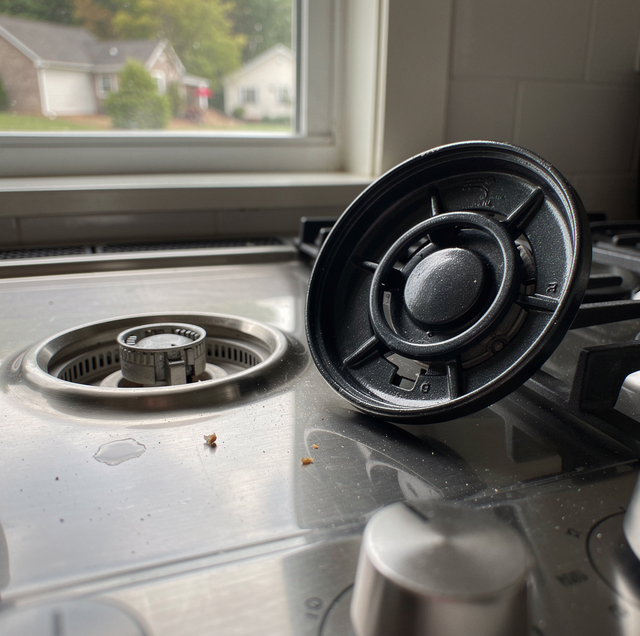
You turn the knob; the burner ticks as it always does, and the flame comes up. Then the ticking keeps going. Or it goes on and on, and no flame ever appears. Either way, the sound is not gas escaping. It is a spark jumping a gap, several times a second, because the range still believes that the burner has not lit. Once you know what the range is watching for, the causes sort into an order, and the first two are ones you can settle yourself.
If you smell gas, stop. Do not switch anything on or off, leave the house with the door open behind you, and call the gas utility and a technician from outside rather than from the kitchen.
The Ignition Circuit Behind the Clicking
Every time you turn a burner knob past the off position, a switch inside the control closes, supplying power to a small electronic box called the spark module. The module steps up the household voltage to several thousand volts and sends it to the electrode, a thin metal pin positioned beside each burner head within a ceramic sleeve. The voltage jumps from the electrode tip to the nearest grounded metal, usually the burner cap or base, and the snap of that jump is the click you hear. On a healthy burner, that spark lights the gas within a second.
Whether the sparking stops is decided by the second half of the circuit. On a flame-sensing range, the same electrode that throws the spark also doubles as the sensor. A flame acts as a one-way conductor, so alternating current pushed through it returns rectified, and the module reads that rectified signal as proof of a real flame rather than a short to ground and shuts the spark off. Interrupt the current and the module goes straight back to sparking. A burner that clicks without end has a control that believes, rightly or wrongly, there is still no flame in front of it. Ranges without flame sensing behave differently. They spark only while the knob is held in its lite detent, so the clicking stops the moment you turn the knob down to a flame setting, lit or not. That is the test for which kind you own. If the ticking carries on after the knob leaves the lite detent, the range is watching for a flame; if it stops there, endless clicking is not something that range can do.
Two Questions That Narrow It Down Fast
Before touching anything, listen and watch. Two observations sort most of these situations before a single part comes off.
Does it click and then light, or click and never light? A burner that lights and keeps clicking already has gas, air, and spark all doing their jobs, so the failure sits in the sensing half of the circuit. A burner that clicks and never lights means the spark is not reaching the gas, or the gas is not reaching the spark. If a burner has not lit within a few seconds, turn the knob fully off and let the area air out for several minutes before trying again, because gas keeps flowing as long as the knob is open.
Is it one burner or all of them? A single burner clicking points at that burner's own hardware: its cap, its electrode, its well. Every electrode sparking while one knob is on is normal on most ranges, but sparking that starts on its own or continues with every knob off points upstream at the shared module or at a switch reporting a knob still open. Make this distinction first: it decides whether the answer lives on the cooktop surface or behind it.
A Burner Cap Off Its Notches
Most clicking calls end at the burner cap, the flat, usually enameled disc that sits over the burner head and spreads the flame across the ports. Its underside carries notches or a locating ridge that has to drop onto matching bumps on the head below. Lift it off to wipe the cooktop, set it back a quarter turn out of position, and it rides high on one side or tilts toward the electrode.
That small misalignment does two things. It moves grounded metal away from the electrode tip, so the spark travels farther and may not reach the gas cleanly. It also distorts the flame ring, so the sensing current starves even when the burner lights. Both push the module to keep firing.
This fix belongs to you. With the burner off and cool, lift the cap straight up and set it back down so it drops flat onto its locating features.
Moisture in the Electrode Well
A pot boils over; the liquid runs down the gap around the burner base, and some of it settles in the recess where the electrode stands. A thorough cleaning does the same. Water conducts, and a wet electrode base offers the high voltage an easier path to ground than the air gap it was meant to jump. The module fires; the charge drains away through the moisture instead of arcing at the tip. Nothing lights, and the module fires again.
This is the cause most likely to look like a dead range and turn out to be nothing. Turn the burner off, dry the well and the cap with a towel, and leave the cap off for a few hours so the recess can air out. A hair dryer on its cool setting speeds that up. Plenty of burners that clicked all through dinner are silent by morning.
Debris Across the Spark Gap
Debris produces the same failure as moisture, only far more slowly. Grease that splatters into the electrode well never evaporates. It bakes into a dark crust that bridges the gap between the electrode tip and the burner base, and that crust conducts just well enough to bleed the spark away. Sugar from a boiled-over sauce does it faster. Loose crumbs and dried residue can also plug the burner ports, so gas barely reaches the side where the electrode waits.
With the burner cool, lift off the cap and the burner head, brush loose debris out of the well with a dry toothbrush, and clear any packed port with a straightened paper clip. Keep liquid away from the electrode and metal away from the ceramic sleeve. The brass fitting at the center of the base is the gas orifice, and it stays where it is. Set the head and cap back the way they came off.
A Cracked Ceramic Insulator
Sometimes the cap is seated, the well is dry, the ports are clear, and the burner still clicks without lighting. At that point, suspicion shifts to the electrode itself, whose white or tan ceramic sleeve is there to hold thousands of volts until they reach the exposed tip. A hairline crack in that sleeve, left by a dropped pot lid, a cap set down edge first, or years of heat cycling, opens a shortcut. The charge escapes through it and grounds low against the burner body instead of arcing across the gap where the gas is.
The tell is a spark visible at the base of the electrode rather than at its point, easiest to see in a darkened kitchen, plus a duller, flatter click than the neighboring burners make. A cracked insulator does not heal and does not respond to cleaning. The electrode assembly is replaceable, but reaching it means getting under the cooktop, where homeowner work ends.
One Burner Versus the Whole Cooktop
One burner clicking is a burner problem; the whole cooktop clicking is a control problem. On most residential ranges, the spark module cannot fire a single electrode on its own. It sends the pulse to all of them at once, and the burner with gas flowing is the one that lights. So every electrode ticking when you turn one knob is normal on a great many ranges and not a fault.
Sparking that begins on its own, or that carries on after every knob has been returned to off, is a real fault. That points at a switch whose contacts are staying closed, often because a spill worked into the switch body behind the knob, or at a module that keeps firing on its own. A tired module can also click weakly, click at an uneven rhythm, or stop firing altogether. All of it sits behind the control panel, alongside the line-voltage and gas plumbing, which puts it firmly in service territory.
Where Homeowner Work Ends
The line between homeowner work and technician work on a gas range is drawn at the gas itself. Reseating a cap, lifting off a burner head, drying a well, and clearing a blocked port stay on your side of it, because none of them disturb anything carrying gas or line voltage. Everything past those four does.
Do not lift the cooktop or pull the range out to reach underneath. Do not disconnect, test, or replace the spark module or its wiring. Do not clean, adjust, or remove an orifice, a valve, or the regulator, and do not try to change a flame's size or color. Those parts carry fuel and power, and a mistake among them is not one you get to make twice.
Do not hold a lighter or match to a burner that has been clicking without lighting. Unburned gas has been collecting around the head, and an open flame introduced into it can flash back at you.
If the cap is seated, the well is dry, the ports are clear, and the clicking continues, the remaining causes sit behind the surface, where the pattern you noticed points a technician straight at the part.
Frequently Asked Questions
The flame is fine to cook on, but the sparking is not free. Spark modules are rated for intermittent duty, not continuous operation, and a range left clicking for days often requires replacing the module even after the original cause is cleared. Use the burner for that meal, then get the sensing path sorted before it becomes a second repair.
Many gas ranges are wired straight into a junction box behind the appliance with no cord to pull, and the ones that do plug in sit against a receptacle you cannot reach without dragging the range out across the floor, which flexes the gas connector behind it. Shut the range off at its breaker instead. That kills power to the spark module while leaving the fuel line untouched, and it holds until a technician can open the control panel.
Regularly. Cleaner sprayed at the cooktop runs into the electrode recess, and that recess is enclosed, so it dries far more slowly than the open surface you just wiped. Most manufacturers ask that cleaner go onto the cloth first and then onto the cooktop, which is the instruction people skip. Clicking that starts within a day of a deep clean is moisture until proven otherwise.
Usually not. Most gas ovens on standard ranges light through a glow bar, a hot surface igniter that heats until it glows orange and opens the safety valve by drawing current, so their ignition failures are silent. Some ranges use a spark electrode in the oven instead, and on those, clicking from the oven cavity can come from the oven's own ignition rather than a surface burner.
The parts are similar, but the exposure is not. On a sealed cooktop, the burner base is sealed to the cooktop surface, so a boil-over stays on top and reaches the cap and the well. On an older open-burner range, the electrode sits under a removable drip bowl, where spills collect out of sight and reach the ignition parts sooner. Those ranges need the well checked more often.
Yes, and it is worth checking once a cap has taken thermal shock, usually from a wet cap set on a hot burner. Set the cap upside down on a flat countertop and look for rocking or daylight under the rim. A warped cap cannot sit flush, however carefully it is aligned, and heavy pitting does the same. Caps are sold individually as replacement parts.
Get a clicking gas cooktop diagnosed — a certified technician checks the electrode, the switch, and the spark module without you going near the gas side. True Appliance Services Inc. serves Maryville, Alcoa, and Knoxville. Call (865) 205-8717.