
Dishwasher Leaving Dishes Dirty? 8 Reasons and Fixes
Quick Answer: Most dirty-dish complaints trace to a clogged filter, spray arms that cannot spin or have blocked jets, water that never gets hot enough, hard-water scale, overloading, tired detergent, or a clogged drain. Cleaning the filter and spray arms and running the tap hot before you start solves most cases. A weak wash pump, dead heating element, or bad control board is where a technician takes over.
You loaded the racks, ran a full cycle, and opened the door to dishes that still feel gritty, filmy, or spotted with dried-on food. A dishwasher that stops cleaning rarely dies all at once. It usually loses performance one small failure at a time, and each cause leaves a slightly different fingerprint on your plates.
Knowing which fingerprint you are looking at tells you whether the fix is a five-minute rinse under the tap or a real repair. Below are the eight most common reasons dishes come out dirty, what each one looks like, and how to sort the parts you can safely handle from the parts that need a technician.
Start With the Filter, the Most Overlooked Cause
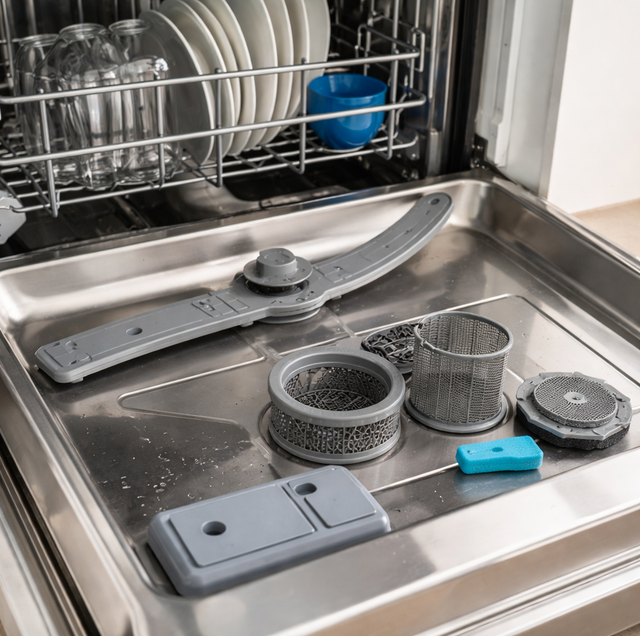
At the bottom of the tub, under the lower spray arm, sits a cylindrical filter assembly that traps food particles so they are not sprayed back onto clean dishes. On many machines, it twists out by hand. When it clogs with grease, seeds, labels, and softened food, the pump can no longer pull clean water, and every cycle recirculates dirty water over your dishes.
A filter is the reason gritty residue lands evenly across everything, not just one rack. If you have never removed yours, that alone can explain months of declining results.
How to clean it: Pull the lower rack, twist the filter counterclockwise, and lift it out. Rinse it under hot tap water, and use an old toothbrush on the fine mesh. Wipe the sump area it seats into, then twist it back until it locks. Doing this every two to four weeks keeps the wash water clean, and it is the single highest-return maintenance task on the machine.
Check the Spray Arms and Their Jets
The spray arms are the spinning bars that fling water up and across the racks. They rely on two things: they must spin freely, and their tiny jet holes must stay open. Either failure starves the top rack, the back corners, or one whole zone of the tub.
Hard-water minerals and food debris plug the jets from the inside. Tall items such as cutting boards, pot handles, or a drooping utensil can physically block an arm mid-rotation, so it stops halfway and only sprays part of the load.
How to check them: With the machine off, spin each arm by hand. It should turn with light resistance and no grinding. Lift the arms off (most pop off or unscrew by hand) and hold them up to the light. Poke a toothpick or a straightened paperclip through any blocked jet, then flush the arm under the tap. Before you close the door on a load, give the arms a spin to confirm nothing is in their path.
Make Sure the Water Is Actually Hot
Detergent enzymes and grease-cutting surfactants need heat to work. Wash water below roughly 120 degrees leaves grease softened but not lifted, so plates come out with a faint film and cups feel slick. This is the cause people miss most, because the machine looks like it is running fine.
The problem is usually the water arriving at the machine, not the machine itself. If your water heater is set low, or the dishwasher shares a line with a fixture that just ran cold, the first fill can be lukewarm.
How to fix it: Turn on the kitchen sink and let it run until the water is hot, then start the dishwasher immediately. That way the first fill draws hot water rather than the cooled water sitting in the pipe. Many machines also have a high-temperature or extra-heat wash option worth turning on.
Run the kitchen sink until the water is hot, then start the dishwasher immediately, so the first fill draws hot water rather than the cooled water sitting in the pipe. Turning on a high-temperature or extra-heat wash option helps too. If water never gets hot even after running the tap, the internal heating element may have failed, which is a technician repair covered further down.
Do Not Overload or Block the Spray
Water cleans by hitting a surface directly. Anywhere a dish shadows another, that spot stays dirty. Overpacking, nesting bowls together, or laying a large platter flat across the bottom rack blocks the very spray the load depends on. It is a bit like standing behind someone under an umbrella; the person in front stays dry, and you get nothing.
Dirty results from overloading show up as clean dishes right next to dirty ones in the same load, a telltale sign the water could not reach.
How to load it right: Face soiled surfaces toward the center and down toward the arms. Leave space between items so water passes through. Keep tall items along the edges where they will not block an arm, and avoid letting utensils poke through the basket far enough to jam the arm below.
Rule Out Tired or Wrong Detergent
Dishwasher detergent absorbs moisture and loses potency over time. A box or a bag of pods that has sat open in a humid cabinet for a year can clump and lose much of its cleaning power. Using hand-dish liquid or the wrong dose also underperforms and can foam over.
Weak detergent tends to leave a light, uniform haze and poor food removal across the whole load rather than one bad zone.
What to use: Buy detergent in smaller amounts you will use within a few months, and store it sealed and dry. If your machine has a dedicated pre-wash detergent cup, fill it too. Adding a rinse aid helps water sheet off dishes instead of beading, which matters more the harder your water is.
Descale Hard-Water Buildup
In areas with hard water, dissolved calcium and magnesium coat the tub, heating element, and spray jets in a chalky scale over time. Scale narrows the jets, insulates the heating element so water warms more slowly, and leaves a white film on glassware. Homes on hard water deal with this regularly, so it is worth checking even on a newer machine.
How to descale: Run an empty hot cycle with a cup of white vinegar in a bowl on the top rack, or use a commercial dishwasher descaler made for the job. Doing this every month or two in a hard-water home keeps the jets open and the element efficient. A rinse aid, used continuously, slows how fast new film builds up between descaling runs.
Clear the Drain and Standing Water
If dirty water cannot leave the tub, the next cycle starts by re-wetting your dishes in yesterday's grime. Water standing in the bottom after a cycle points to a clogged drain hose, a blocked garbage-disposal knockout plug, or trapped food in the sump. Suds or a sour smell often come with it.
How to clear it: Scoop out standing water, then check the drain path. A common culprit is the knockout plug inside a newly installed disposal that was never removed, which stops the dishwasher from draining at all. Clearing accessible food from the sump and confirming the drain hose has no kinks resolves many cases. If water keeps standing after that, the drain pump may be failing.
When It Is a Wash Pump, Heating Element, or Control
The homeowner-safe list ends with cleaning, clearing, and loading. When those are done, and dishes still come out dirty, the failure is usually electrical or mechanical inside the machine. A worn wash pump cannot build enough pressure to spray hard, so arms barely turn even when clean. A dead heating element leaves water cold no matter what you do. A faulty control board can skip the heat or wash stages entirely.
Before anyone reaches near the wash pump or heating element, unplug the dishwasher or shut off its breaker. These parts sit near water and line voltage, and diagnosing or replacing a pump, heating element, or control board is a technician job, not a homeowner fix.
Dirty is not the same as cloudy: One quick distinction saves a lot of guesswork. Food residue, grit, and greasy film mean a cleaning problem, and the causes above apply. A permanent cloudy or rainbow-etched look on glassware is different. That is hard-water film or, in some cases, glass etching from very soft water plus too much detergent, and it will not scrub off. Treat cloudiness as a water-chemistry and rinse-aid issue rather than a broken wash cycle.
Frequently Asked Questions
The top rack is usually fed by the middle spray arm and a water feed tube that runs up the back of the tub. If that upper feed is clogged with scale or a food chunk, the lower rack still cleans while the top rack goes hungry. Check that the middle arm spins and that the water tube outlet at the top of the tub is clear before assuming the machine is failing.
Heavy scraping: yes; full pre-rinsing: no. Modern detergents contain enzymes that need some food residue to grab onto, so a spotless pre-rinsed load can actually clean worse and leave etching. Scrape off bones and large scraps, but leave the light soil. This matters most on eco or auto cycles that dose detergent based on how dirty the water is.
Short cycles skip the longer soak and hotter final rinse, so they suit lightly used dishes only. Baked-on or greasy loads need a normal or heavy cycle to reach full wash temperature and give enzymes time to work. If dishes are dirty only on the quick cycle, the machine is fine, and the cycle choice is the issue.
For an average household, every two to four weeks. If you cook often, rarely scrape plates, or run the machine daily, move to weekly. A filter that has gone months without cleaning can grow a biofilm that smells and reduces wash pressure even after a rinse, so a badly neglected one may need a soak in warm soapy water to recover fully.
That cloudiness is almost always hard-water mineral film or, less often, etching from too-soft water combined with over-dosing detergent. Unlike food residue, it is a surface reaction, not leftover dirt. A vinegar rinse will temporarily clear mineral film; permanent etching cannot be reversed and calls for less detergent and a rinse aid going forward.
It can. The air gap is the small chrome cylinder on the countertop or sink that prevents drain water from siphoning back into the machine. If it clogs, water drains poorly and can back up into the tub, leaving debris behind on the next fill. Popping off its cap and clearing any food lodged inside restores proper drainage in many stubborn cases.
Book a diagnostic visit — get a straight answer on whether it is a cheap fix or a failing part. True Appliance Services Inc. serves Maryville, Alcoa, Knoxville. Call (865) 205-8717.
