
Your oven door has been shutting the same way for years, and lately the handle end has gone warm enough to notice while something bakes. A faint brown track has appeared on the frame just outside your door's edge, or the door now needs a push through the last of its travel before it settles.
A seal on an oven is a compression fit. The braid running around the opening does nothing on its own; it works only when the closed door presses it flat against the frame at every point along its run. So the seal can fail with the gasket still in one piece, and it can fail because of a part sitting nowhere near the gasket.
Compression Around a Hot Opening
The braid does not run all the way round, and that is deliberate. A gap at the bottom of an oven door is normal, left open rather than covered by a gasket, because fresh air is pulled in low to replace air rising out through the oven vent. The run of seal on your door is interrupted by design, so the remaining length carries the sealing work.
Even compression is what does the work here. A gasket pressed hard at your latch side and barely touched at the hinge side is closed in one place and open in another, and hot air finds the open part within minutes of the element coming on. A leak at your oven door is a local one. It sits wherever the braid has gone flat or been pushed aside, and the run either side of it can be perfectly sound.
What Makes an Oven Gasket Stop Sealing?
The gasket is a braided fiberglass rope, and its job is springback. Woven fiber holds its shape with air trapped in the weave, and that loft lets a thin braid fill a gap of uneven width. Take the loft away and the same part stops pushing back.
Years of service do exactly that. Heat and the weight of the door work on the fiber through thousands of closings, and the braid ends up compressed and holding less air than it did new. A braid that has lost its springback can still fill your hand, so a flattened gasket looks perfectly serviceable. Force, not thickness, is the property a seal needs, and force is the first thing to go.
Cleaning does the other half of the damage. The door gasket on a self-cleaning range should never be cleaned because the fiberglass material cannot withstand abrasion. The gasket must remain intact, and any worn or frayed gasket should be replaced rather than cleaned. A pad taken to the braid pulls fiber out of the weave, and the thinned length is where your door starts to leak.
The Clips and Channels That Hold It in Place
A gasket that is not in its proper position behaves exactly like a worn one. Retention varies by model: some seals seat into a channel formed in the door liner, and others hook through holes punched around the opening and finish in a pair of pins at the bottom. The appliance's owner's manual and parts list name which arrangement your machine uses, and both are worth reading before ordering a part.
A clip that has let go leaves a length of braid standing proud of the door face while the rest sits where it should, and your door closes on the high spot and stops short everywhere else. Your door then reads as a ruined gasket at the handle end and a healthy one at the hinge. Wear and displacement look identical from the front of a door, but require different work.
Reading the Closed Door From the Front
Warm air at the edge of a closed door is not by itself a fault. Some heat leaking around an oven door is normal, because the oven needs airflow for even baking, and a major leak instead shows up as scorching or smoke stains on the oven face. A stream at one short stretch of your door's edge sits between those descriptions.
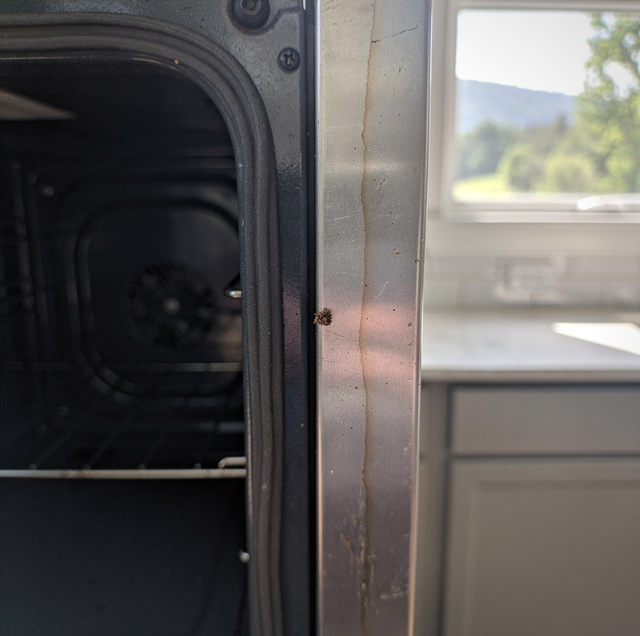
Your oven's frame keeps the record. Escaping air leaves oil and moisture on the cooler metal just outside the opening, so a long-running leak darkens a track where the seal stopped touching.
The last part of the door's travel is where the seal is actually made, and it is also where you notice a change. A door that used to fall shut and now needs a push is meeting more resistance than it did, which feels like a stiff hinge and can equally be a gasket swollen with baked soil or shifted out of its channel into the door's path. A door that once needed a firm push and now swings closed against nothing has lost resistance, which is the tired braid. Both readings come out of one movement, and a technician takes them in a fixed order, resistance first and then where along the run it changed, because the second question means nothing until the first has an answer.
Steam provides the same information throughout a long roast. Moisture leaving the cavity condenses on whatever cool metal it reaches first, so a wet line on your frame or a wisp at one corner marks the leak while the oven is at temperature and the door is carrying its working load.
None of that separates a worn gasket from a sound one being held badly, and none of it explains how a seal manages to fail at opposite corners at once.
The Hinges Under a Door That No Longer Sits Square
Once a door stops meeting the frame square, it crushes your seal at one corner and leaves it standing clear at the diagonally opposite corner, so a single gasket fails in opposite ways within the same cycle while the braid itself is sound. Fitting a new seal puts fresh material into the same crooked grip, and it flattens at the crushed corner within a few months of ordinary baking.
Your oven door hangs on a pair of spring-loaded hinges whose arms drop into slots in the cavity's front frame, and each arm carries a lock that holds the door where it was built to hang. With the hinges properly installed and the door closed, there should be an even gap between the door and the control panel. If the door sits lower on one side, the hinge is not properly installed.
The gap at the top of a closed oven door lets you do the same check without tools. That gap is normal, and it should be even across the top, and a side-to-side difference in it, once the door has been in ordinary use for a while, is the point at which service should be scheduled. A gasket ordered for a door in that state is asked to take up slack a hinge gave away.
Frequently Asked Questions
The cycle cleans the cavity inside the gasket ring, not anything outside it. The area inside the gasket is cleaned during the self-clean cycle and needs no hand cleaning, while soil on the front frame and on the door outside the gasket has to be cleaned by hand. The band of soil you can see nearest the seal afterwards is the part you were always going to wipe.
A new braid still has its full loft, so it stands taller than the flattened one it replaced, and your door meets it earlier in its travel. The gap equalizes as the gasket takes a set after a few weeks of use, so the stiffness you feel in your first week is not evidence your part is wrong. Cook as you normally would and look again.
Closing the door onto the gasket leaves a contact impression along the braid, a flattened line marking where the frame has been pressing. Reading that line around your oven shows where the compression stops, and the corners get read before the straight runs, because a door that has moved shows at a corner while the middle of an edge still looks convincing.
No commercial oven cleaner or oven liner protective coating of any kind should be used in or around any part of the oven, and any residue left behind will damage the interior when a self-clean cycle runs. The gasket itself should be left alone, and your own manual is the place to confirm that for your machine. If your braid is soiled, let a technician handle it for you.
Not on its own. The visible gap at your closed oven door is not a reflection on how well the oven is sealing, and the caution runs both ways: what your food does is a poor guide to what your door is doing. Uneven browning belongs to the heating and calibration side of the oven.
No, the haze sits elsewhere in your door. Your gasket seals the perimeter of the opening; the film you see is on the inner pane of your door's glass, inside an assembly you cannot reach from either face. The inner and outer oven door glass are separate parts, and on models where a simple set of steps does not apply, taking the door apart calls for a service visit.
Book an oven and stove repair visit — the gasket cannot be judged from outside a closed door, and the replacement seal is ordered to your model and the way it is retained at the door. True Appliance Services Inc. serves Maryville, Alcoa, and Knoxville. Call (865) 205-8717.