
Why Does My Oven Heat Unevenly? 8 Causes to Check
You slide in two sheet pans of cookies, set the timer, and pull them out to find one tray golden and the other barely set. Or a casserole browns beautifully on top while the center comes out cool. When an oven browns one side, undercooks the middle, or drifts off the temperature you set, it is telling you something specific about how it makes and moves heat. Some of those causes you can correct in a few minutes. Others mean a part has failed and needs a technician. Knowing the difference saves you from either a repair you did not need or a ruined dinner you could have avoided.
Quick Answer: Uneven oven heat comes down to two systems: heat production and heat movement. A weak element, a failing sensor, or a drifting control changes how much heat the oven makes. A dead convection fan, a bad door seal, or crowded racks change how that heat spreads. Confirm the problem with a separate oven thermometer first, then decide whether it is a calibration and airflow fix or a failed part.
How an Oven Actually Holds Its Temperature
Think of your oven the way you would a car's cruise control. You set a speed, and the system constantly makes small corrections to hold it, easing off when you are going too fast and pressing down when you slow. An oven does the same thing with heat. You choose 350, and the control cycles the heating elements on and off to hover around that number, reading the real temperature many times a minute and correcting as it goes.
That loop depends on three things working together. Something has to make heat, usually a bake element at the bottom and a broil element up top in an electric oven, or a burner in a gas model. Something has to measure the temperature, a small probe called the oven sensor. And something has to run the show, the thermostat or control board that decides when to switch the heat on and off. When any one of those three drifts or fails, the oven stops holding its setpoint the way it should, and you see it on the food.
Heat movement is the second half of the story. Even a perfectly working element creates hotter zones near itself and cooler zones farther away. Ovens with convection add a fan to push air around and even things out. Without that circulation, or with racks and pans blocking the flow, heat piles up in one place and starves another.
The Common Causes, From Simple to Serious
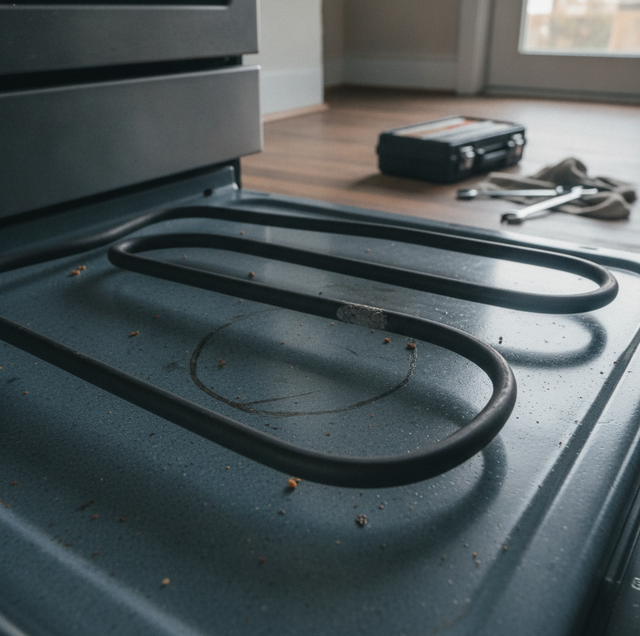
A weak or failing heating element: In an electric oven, the bake element is the coiled bar along the floor of the cavity. Over years of expanding and contracting, it can develop a weak spot, blister, or partial break. A partially working element still glows in places but heats unevenly, which is why one side of a dish cooks faster. A healthy element glows an even red-orange along its whole length when it cycles on. Dark or dull sections are a warning sign.
A bad oven sensor: The sensor, a thin metal probe usually mounted at the upper rear of the cavity, feeds the actual temperature to the control. When it drifts, the oven's idea of "350" no longer matches reality, so the whole cavity runs hot or cold even though the display looks right. This is a frequent and easily missed cause of an oven that bakes everything too dark or too pale.
A failed or drifting thermostat or control board: Older ovens use a mechanical thermostat; newer ones use an electronic control board. Either one can lose its accuracy over time or fail outright, letting the oven overshoot and undershoot instead of cycling tightly around the target.
A convection fan that has stopped: If your oven has convection and that fan quits, the oven loses the circulation that keeps the temperature even, and you are back to hot and cold zones. You may still get heat, just not evenly distributed.
Blocked airflow from crowded or misplaced racks: Too many pans, trays shoved against the walls, or a rack in the wrong slot all disrupt airflow through the cavity. This mimics a mechanical fault but is entirely a loading problem.
A warped or dirty element or burner: A bent element or a gas burner port clogged with grease and debris burns unevenly, throwing more heat in some directions than others.
A bad door gasket or seal: The gasket around the door keeps hot air inside. If it is torn, hardened, or misaligned, heat leaks out along that edge, and the side nearest the leak runs noticeably cooler than the rest of the oven.
A miscalibrated oven or an uneven gas burner: Sometimes nothing is broken; the oven simply reads a few degrees off from the factory or has drifted. In a gas oven, an igniter that is weakening or a burner that lights unevenly can also produce lopsided heat.
What You Can Check Yourself
A handful of these causes are squarely in homeowner territory, and none of them require opening the oven up.
Start with a separate oven thermometer, the kind that hangs on a rack. The oven's own display can be off by a surprising amount, so you want an independent read before you conclude anything. Set the oven, let it fully preheat, and give it several extra minutes to stabilize before you trust the number.
Rotate your pans partway through cooking and avoid overcrowding. Some hot spots are normal in every oven, and simply turning the tray halfway through evens out most everyday baking. Give pans room so air can move around them, and keep them off the cavity walls.
Check that your racks are in the positions the recipe or manual calls for. Middle-rack placement is the default for most baking because it sits the food in the most balanced part of the cavity.
Inspect the door gasket. Run your hand along it (when the oven is cool) and look for tears, gaps, flattened spots, or grease buildup that keeps the door from sealing. A door that does not close leaks heat snugly.
Finally, if your manual describes a temperature offset or calibration adjustment, use it. Many ovens let you nudge the setpoint up or down a few degrees to match your oven thermometer, which fixes a small, consistent error without any parts at all.
When to Call a Technician
Once you have ruled out loading, sealing, and calibration, an uneven oven usually means a part has failed, and that is where a professional comes in. The heating element, oven sensor, thermostat, control board, convection fan, and any gas burner or igniter component all sit in that category. These involve electrical connections, high heat, and, in gas models, a fuel supply, so they are a service call rather than a weekend project.
A useful way to sort it out: a calibration or airflow issue is easy and often free to correct, because the oven's hardware is fine and you are only adjusting how you use it. A failed element or sensor is a repair, because a component has physically stopped doing its job, and adjusting the settings will not bring it back. If your oven thermometer confirms the temperature is clearly wrong or wildly uneven after you have handled the simple stuff, that is your signal to bring in a technician rather than keep guessing.
One safety note worth stating plainly. Ovens combine high heat with either high-voltage electricity or a gas supply, and some of the parts involved are there specifically to keep the appliance safe. Do not bypass a safety component to force an oven to run, and do not attempt gas burner or igniter work yourself. A trained technician can test the element, sensor, and control, confirm which one is at fault, and replace it correctly.
Frequently Asked Questions
Put an oven thermometer on the center rack and let the oven fully preheat, then read it against your setpoint. Move the thermometer to different corners on later runs and compare. Every oven has some hot spots, and rotating pans fixes those. But a reading that sits far off the setpoint, or one that swings wildly from one corner to another, points to a real fault rather than normal variation.
A small probe called the thermistor reports the actual cavity temperature to the control board so the oven knows when to cycle the heat on and off. When that probe drifts or fails, the oven overshoots or undershoots the number you set. A sensor reading wrong is one of the most common reasons an oven bakes hot or cold across the board, even when the display shows the right temperature.
That pattern usually points to a weak spot in the bake element, a convection fan that is not circulating air, or a door seal leaking heat along the cooler side. Which side is off actually helps narrow the cause: a consistently cool edge often traces to a leaking gasket on that side, while random unevenness suggests the element or fan.
Many ovens include an offset adjustment in the settings that lets you nudge the temperature up or down to match a trusted oven thermometer. That corrects a small, consistent error, say an oven that runs fifteen degrees low everywhere. What it cannot do is fix a failed element or a sensor that reads erratically, since those are hardware faults, not a settings problem.
Yes. Pans packed tightly together, or a rack lined with foil, block the hot air from moving freely around the food. Heat then piles up in some spots and starves others, which is exactly why baking guides tell you to space pans out and to keep racks clear rather than lining them with foil. Airflow is doing more of the work than most people realize.
A control thermostat or board that is failing, or a heating element that only partly works, can let the oven swing widely instead of cycling tightly around the setpoint. That inability to hold any steady temperature is a different problem from being a few degrees off, and it is a repair rather than a calibration tweak, because a component has stopped doing its job.
Schedule an oven diagnostic today — get even, reliable heat back in your kitchen. True Appliance Services Inc. serves Maryville, Alcoa, and Knoxville. Call (865) 205-8717.
