
Quick Answer: A refrigerator is supposed to cycle on and off, so constant running means one of two things: it can't reach the temperature it's aiming for, or something is telling it to work harder than it should. The most common and easiest fix is dirty condenser coils, followed by a bad door gasket, blocked vents from an overpacked box, a setting that's too cold, or a hot spot around the unit. More serious causes include a frost-clogged evaporator coil from a failing defrost system or a sealed-system refrigerant leak. Start by feeling whether the food is actually cold. A fridge that runs a lot but keeps everything cold is usually a simple airflow or coil issue. A fridge that runs constantly and is slowly warming up is more urgent.
A refrigerator that hums all day long feels like it should be doing its job well. In reality, a healthy fridge spends a good chunk of every hour switched off. It cools the box down, reaches its target, and shuts the compressor off until the temperature drifts back up. So when you notice the motor never seems to rest, that steady drone is telling you something: the appliance can't get ahead of the heat, or it's being asked to fight harder than it needs to.
The good news is that the most common reasons are things you can see and often fix in an afternoon. The trick is knowing where the clue points are. Below, you'll walk through the causes from the everyday to the serious, and learn the quick tests that tell them apart.
First, Figure Out Whether It's Still Cold
Before you chase any single part, answer one question: Is the food actually cold, or is it warming up? This single check splits the problem in half.
Open the door and feel a carton of milk or a jar in the back. If everything is properly cold and the freezer is firm, your fridge is running long but still winning the fight. That usually points to something making it work a little harder than needed: dusty coils, a weak seal, a hot kitchen, or a setting nudged too low. Annoying and wasteful, but not an emergency.
If the box feels cool instead of cold, or the freezer is soft and the ice cream is slushy, the fridge is running constantly and still losing ground. That's the more urgent version, because it points toward a cooling-system fault: a frost-clogged coil, a failing defrost system, or a refrigerant problem. Food safety is on the clock here, so this is the case to act on quickly.
The Simple Causes You Can Check Yourself
Dirty Condenser Coils
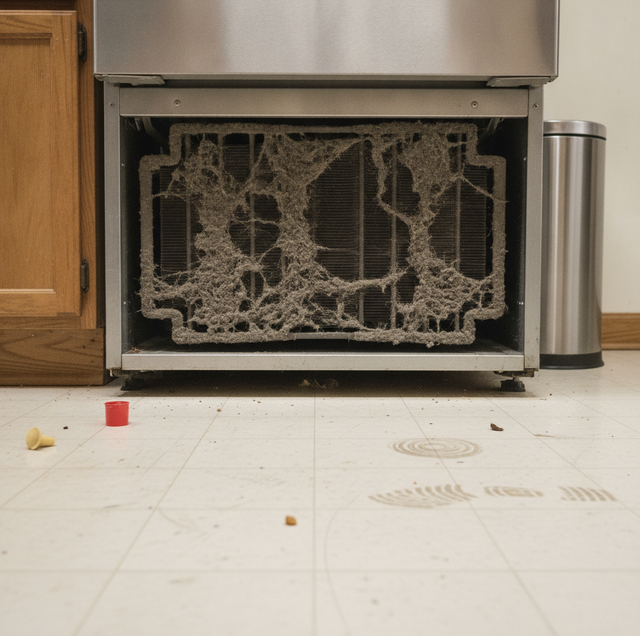
This is the number-one easy cause, and it's worth checking first every time. The condenser coils are the fridge's radiator. They carry the heat pulled out of the food compartment and release it into the room. On most units, they sit behind a snap-off kick plate at the bottom front or across the back.
Think of the coils like the radiator in a car. As long as air can move through them freely, they dump heat and the engine stays cool. Blanket them in dust, pet hair, and kitchen grease, and that heat has nowhere to go, so the compressor keeps grinding to make up the difference. Homes with shedding dogs or cats clog coils fastest.
To check them, unplug the fridge, pop off the kick plate, and look. If you see a gray felt of dust, that's your answer. Vacuum it off with a brush attachment, and use a slim coil brush to reach the fins. Most manufacturers suggest cleaning the coils every six to twelve months, and more often in a pet household. It's the single most effective thing a homeowner can do to stop constant running.
A Door Gasket That Isn't Sealing
The rubber gasket around the door is what keeps warm room air out. When it hardens, tears, or collects grime, warm air leaks in around the edges, the interior heats up, and the compressor never gets a break trying to counter it. In humid summers, that leaking warm air also carries moisture, so a weak seal often shows up as sweating or condensation around the door frame before you ever notice the running.
There's a simple test. Close a dollar bill or a sheet of paper in the door so half sticks out, then tug it. A good seal grips the paper, and you feel resistance. If it slides out easily or falls, the gasket isn't sealing at that spot. Walk the paper around all four sides, since a seal can be fine on top and shot at the bottom. Wiping the gasket clean and warming a stiff one sometimes restores the seal; a cracked or permanently deformed gasket needs replacing.
An Overpacked Box or a Door Left Ajar
A refrigerator cools by circulating air, so it needs open lanes. Cram the shelves wall to wall, or push a tall casserole against the rear vents, and the cold air can't move. Parts of the box stay warm, the thermostat keeps calling for more cooling, and the compressor runs on. A drawer or door that won't fully latch because a container is in the way does the same thing, and it's easy to miss. Give the vents at the back and the freezer some breathing room and confirm the door clicks shut on its own.
A Setting That's Simply Too Cold
It sounds obvious, but a dial bumped during cleaning or set optimistically low will make the fridge run far more than it needs to. The standard targets are about 37 degrees for the fridge and 0 degrees for the freezer. Set it colder than that and you're asking the compressor to chase a temperature it struggles to hold, which means longer run times for no real benefit. Check the setting before assuming the worst.
A Hot Kitchen or Tight Clearance
A fridge sheds heat into the air around it, so it needs room to breathe on the sides, top, and back. Shove it into a tight cabinet, back it against a warm wall, or park it beside an oven or in a sun-baked corner, and it can't get rid of heat, so it runs longer. This is the one truly seasonal piece, and it cuts both ways. A hot summer kitchen makes the fridge work harder to hold its temperature, but a garage fridge in a cold snap can struggle too, because some units misread the chilly surroundings and short-cycle or run oddly. Year-round, the fix is the same: keep a little air gap around the unit and keep it away from direct heat sources.
The Causes That Point Toward a Repair
Frost Clogging the Evaporator Coil
Inside the freezer, behind a panel, sits the evaporator coil that actually makes the cold. Every fridge runs a defrost cycle now and then to melt off the light frost that naturally forms there. When the defrost system fails, that frost never melts. It forms a solid block of ice over the coil; air can no longer pass over it, and cold no longer reaches the food. The compressor responds the only way it knows how: by running nonstop, trying to cool a box it can no longer cool.
The tell is a fridge that runs constantly while slowly warming, sometimes with visible frost caked in the freezer or a fan that sounds like it's ticking against ice. The defrost system has a few parts that can fail, including the defrost heater, the defrost thermostat, and the timer or control that schedules the cycle. Pinning down which one has quit is a diagnostic job for a technician, since it takes testing rather than guessing.
A Sealed-System or Refrigerant Problem
Refrigerant is the working fluid that carries heat out of the box, and it circulates through a closed loop called the sealed system: the compressor, condenser, evaporator, and the lines between them. In normal operation, that loop never loses refrigerant, because it's sealed. If a leak develops somewhere in it, there's less refrigerant to move heat, cooling fades, and the compressor runs continuously trying to make up for a job it no longer has the means to do.
The signature is a fridge that runs without stopping and keeps getting warmer, no matter what you clean or adjust. This is not a homeowner's repair. Sealed systems are pressurized, the refrigerant is regulated, and the work requires recovery equipment, leak detection, and specialized certification. If the coils are clean, the seal is good, the vents are clear, and it still won't hold temperature, this is the point to call a professional rather than keep tinkering.
A Failing Thermostat or Control Board
Sometimes the cooling hardware is fine, and the fridge is simply getting bad orders. A failing temperature sensor or a glitchy control board can misread the interior or forget to end the cooling cycle, so the compressor keeps running even after the box is cold enough. Summer storms and power flickers are hard on control boards over time. A control fault is tricky, because from the outside it looks like a fridge that runs constantly for no visible reason, which is exactly why it's worth a technician's meter rather than a parts-swapping guess.
When Constant Running Is Actually Normal
Not every hard-working fridge is broken. A brand-new refrigerator, or one you just moved, will run for many hours straight as it pulls a room-temperature box down to setpoint for the first time. The same goes right after a big grocery haul: load in a warm week's worth of food, and the fridge has to chase all that heat back out, so it runs long until it catches up, often for the better part of a day. A fridge propped open while you clean, or one in a heat wave, will also run more than usual.
The rule of thumb is simple. If the fridge is running a lot but the food stays properly cold, and it settles back into cycling within a day of a big load or a fresh start, that's the appliance doing its job, not failing at it. It's the constant running paired with a warming box, or the running that never eases off, that earns a closer look.
A Safe Order to Work Through It
Start with what's free and safe. Feel whether the food is cold, check the temperature setting, clear the vents, and run the paper test on the gasket. Then unplug the unit and vacuum the condenser coils, which resolves a real share of these cases on its own. Always pull the plug before you reach behind or beneath the fridge, since fans and electrical parts are live back there.
If the coils are clean, the seal is tight, the vents are clear, and the box is still warming or the motor still won't rest, the trail leads to the defrost system, the sealed system, or the controls. Those call for testing and, in the case of anything involving refrigerant, certified hands. A fridge that's slowly warming is also a food-safety clock, so it's not one to leave running for weeks while you hope it sorts itself out.
Frequently Asked Questions
For a stretch, yes. A fridge fights the heat around it, so a hot kitchen naturally lengthens run times, and a load of warm groceries can keep the compressor going for much of a day while it pulls all that new heat back out. The key is recovery: a healthy unit should settle back into on-and-off cycling within about 24 hours of the big load, and the food should be firmly cold the whole time. Running that never eases off after a day, or a box that keeps warming, is the version worth investigating.
A few overlooked spots. The condenser fan sits near the coils and pulls the same dust and pet hair, so wipe its blades when you do the coils, since a fouled fan can't move heat even off clean coils. Inside, keep the vents between the freezer and fresh-food sections unblocked by boxes and bags, because that's how cold air circulates, and a covered vent makes the compressor run to compensate. Give the whole unit a few inches of clearance at the back and sides so it can shed heat instead of recycling its own warm air. And wipe the door gasket now and then, since crumbs and grime on the seal keep it from closing tight and let warm air leak in for the compressor to chase.
Close a dollar bill or sheet of paper in the door with half sticking out, then pull. A good seal grips it, and you feel drag; if it slides free, the gasket isn't sealing at that spot, so test all four sides since one edge can fail while the rest hold. Many gaskets are a bolt-on or push-in part that a handy owner can swap, but the replacement has to match the exact model, and some styles are fussy to seat evenly. If the door won't close square afterward, that's a sign to have it fitted properly.
The widely accepted targets are around 37 degrees Fahrenheit for the fresh-food compartment and 0 degrees for the freezer. Those numbers keep food safely cold without asking the compressor to chase a temperature it can't comfortably hold. Setting the fridge much colder doesn't preserve food better; it mostly just lengthens run times and can freeze the produce at the back. If your fridge only has a numbered dial instead of a temperature readout, set it to the middle and put a cheap thermometer inside for a day to dial it in.
It does both, which is why it's worth fixing rather than ignoring. A compressor that never rests draws power the whole time, so a fridge running nonstop uses noticeably more electricity than one cycling normally. It also runs hotter and logs far more hours than it was designed for, and heat and run-hours are what age a compressor. Catching the simple causes early, especially dirty coils, spares the most expensive part in the appliance from years of avoidable strain.
Age and the type of failure decide it more than anything else. A refrigerator still within its typical service life, roughly the ten-to-fifteen-year range, that runs nonstop because of coils, a gasket, a fan, or a defrost part is worth repairing, since those are simple fixes. The calculus shifts when an older unit develops a sealed-system fault like a refrigerant leak or a failing compressor, because that's the most involved repair on the appliance, and it's landing on a fridge already near the end of its life. A technician can tell you which camp yours is in, but the rule of thumb is simple: a simple part on a newer fridge, fix it; a sealed-system failure on an aging one, weigh replacement.
Schedule a diagnostic with a certified technician — pinpoint why your fridge won't stop running and get it cycling right again. True Appliance Services Inc. serves Maryville, Alcoa, and Knoxville. Call (865) 205-8717.
